
Drive into St Quentin la Poterie from Uzes and, as one turns the corner and the village opens up ahead of you, there is a prime piece of real estate on your left. But it's not been developed with modern villas. It's not going to be the site of the new swimming pool or the new decheterie. It's a vineyard, and I like to think that this is an indication of where the priorities lie in this village.

St Quentin is home to a score or more working potters and is the centre of the European ceramics industry - we've just hosted the annual Terralha, le Festival Européen des Arts Céramiques, a four day exhibition which takes over not merely the potteries but many private houses and attracts visitors from all over the world. But, despite the name, there are probably more people making wine in the village than there are making pots, and within a few kilometres one can find vin de pays Duche d'Uzes, vin de pays d'Oc, vin de pays Cevennes and, of course, Cotes du Rhone. We're also pretty close to Costiere de Nimes.

So, are we spoilt for choice? Well, yes and no. The wines from the local co-operative are ok, although for everyday drinking red we will head for the nearby village of St Dezery, where the traditional Duche d'Uzes blend of Syrah and Grenache has delicious vanilla undertones that come to the front of the palate when slightly chilled. (For our rose, it is always Jean-Marc Floutier's Gris from the foot of the Cevennes in Savignargues.)

This year, however, we've discovered two vignerons who are - and have been - right under our noses all this time.

The first is Agarrus, named after the Provencal word for the small kermes oaks of this region. The wines are a blend of Syrah, Grenache, Carignan and Cinsault. The cheaper of the two is a VdP Cevennes; the better and only very slightly more expensive is VdP Duche d'Uzes. Both are good, honest wines, with no pretension.

But what makes them notable is that they are made by our postman, Serge Scherrer. I usually have a glass of his wine in my hand when I hear his scooter stop outside our courtyard gates around lunchtime as he delivers the latest bundle of junk mail from Carrefour, Intermarche and Mr Bricolage.

Serge is from Alsace originally, and was transferred to the Uzege ten years or so ago and discovered that he was at last financially able to fulfil his ambition to make wine. Although he grew up with Gewertz, Pinot Gris, Sylvaner and so on, he has embraced the culture of this area totally and the distilled essence of the Uzege can be found in every bottle of the vintage I'm currently drinking, the 2009.

My second vignerons have come from farther afield even than Alsace. Amy Lillard and Matt Kling are American, and they live and make their wine almost opposite the (iconic for me) vineyard in St Quentin la Poterie. Their vineyards, however, are in Castillon du Gard, which makes them part of the Cotes du Rhone appellation.

The wines are organic and biodynamic and have serious structure. They are very good. Currently, we're drinking the 2008, which is the year that www.garagistewine.com discovered them, and I can see and taste exactly what attracted Jon Rimmerman to the wines. It's not merely about small volumes, it's about terroir and authenticity and honesty and love. La Gramiere has all these things in its 2008 manifestation.

I have a glass with me as I write. It's full of fruit, but not fruity. It's actually quite tart, with a good balance of soft, fully integrated tannins and enough acidity to keep it honest. It's gorgeous - my kind of wine.

(My only complaint? I've just noticed an errant apostrophe in the copy on the back label.)

This year, Jill and I have volunteered to help with the vendage at La Gramiere. Despite our love of wine and residence down here all these years, it will be our first. And we are honoured and privileged to be allowed to get up early and hand-pick those beautiful grapes and, in this way, contribute to another excellent vintage.

Today's listening: Has to be Amy Winehouse. She never produced anything as good as those other 27 year olds, but she might have done, one day, had she got clean and lived.
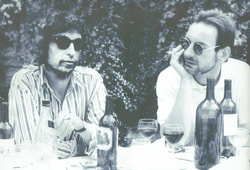
 
 
George Parker's long-awaited Confessions of a Mad Man was published electronically yesterday. I need to declare an interest. He was/is a friend. I worked with him in an ad agency many years ago, I'm pretty sure that his son Chris is godfather to my eldest daughter, and George recently gave me an unsolicited reference on a business networking site: "If he's still alive, he's a prince" he wrote. (I am and I'm not.)

When I say I worked with him, I didn't really. George spent most office hours in the betting shop, so it was only during licensed hours - lunchtime and evening - that we bonded.

But, in those days, and as George makes clear, it was during extended licensed hours that most of the work of our agency was carried out. By the time we met, in the '70s, the events which George describes in his wonderfully foul-mouthed and politically incorrect book (he writes as he talks) were almost over. But not quite. There were still people like George around who were determined to drain every last drop from the bottle.

These days, George writes his AdScam blog, which daily records the stupidities and inanities of those he calls the 'fucktards' and 'douchenozzles' of the advertising industry. His book, despite its breathless prose, is actually a more considered version of all his columns, punctuated by some great stories.

Some of them I have heard before - the one about how he almost lost his life on the world's most expensive TV commercial shoot. Others are new to me - for example, his argument with a client over bullet points in copy: George won by quoting spurious statistics from the equally spurious Institute of Datametric Cognitive Studies. That's creative.

The stories are great, but they are there to illustrate a serious point about marketing in general and advertising in particular. As an insider, as well as initiator and active participant in much of the idiocy, there can be few people still alive with better credentials to expose, judge and warn.

His title, of course, alludes to both the recent TV series Madmen and to David Ogilvy's famous book. But really, it references George himself. When I first met him, he bore a striking resemblance to Animal, the drummer in The Muppets. He probably still does, but he's stuck out in the sticks in Idaho so I haven't seen him since a very modest reunion lunch in Wilde's a few years ago.

George was sufficiently sane to buy into the insanity which he found in the advertising industry on both sides of the Atlantic and to exploit it ruthlessly. His colleagues and employers probably thought him mad, but actually he was the sane one. He knew advertising was, as he respectfully quotes Orwell, "the rattling of a stick inside a swill pail". And George could rattle the stick pretty good.

These days, for all I know, he is still charging some insane day rate to BDAs (Big Dumb Agencies) and presenting shit to douchenozzles at BDCs (Big Dumb Clients). But I do know he is still drinking, because he tells us in his crazy blog at: www.adscam.typepad.com. You've got to be pretty involved in the industry to go there every day, but there are enough great moments for even outsiders to relish.

Or of course you could go buy the book on Kindle. It's worth a great deal more than the £3.50 or so that he and Amazon, between them, will charge you.

Today's listening: Elbow, Build a rocket boys. Paul Bernard in Florida and the Mercury Prize nomination prompted us to take another listen today. Sorry paul, still not convinced.


E.M. Forster famously remarked that "If I had to choose between betraying my country and betraying my friend, I hope I should have the guts to betray my country".

Forster, writing just before the outbreak of the second world war, was arguing in his Bloomsbury way that the modern state was in itself opposed to personal relations. And it was personal relations which should form the basis of a good life.

I won't bore you with a re-hash of my 1968 critique of the philosopher G.E. Moore's Principia Ethica, from which Forster's statement is derived; suffice it to say, I don't agree. But the proposition is relevant to the l'affaire Murdoch, because most of the major players are 'friends' and Cameron himself made great play of the fact that Coulson 'is a friend and remains a friend', adding that he would have to be a particularly 'unpleasant sort of person' were he to renege on his offer of a 'second chance'.

That dinner party in Chipping Norton about which I've been banging on all year (David Cameron, James Murdoch, Rebekah Brooks) was not a meeting between a prime minister, a chairman of News International and an editor of the News of the World. It was, Cameron told us and Parliament, just a few friends having dinner: the subject of the BSkyB shares was never mentioned.

But that was then. Once the sluice gates had been opened, Cameron was forced to make the choice. And he made the choice that one would expect. He was going to have to be precisely the 'unpleasant sort of person' he wished not to be. His friend Rebekah Brooks should go. Andy Coulson should go. No more weekends at Chequers for these guys.

It is 60 years since Jeremy Thorpe summarised MacMillan's sacking of most of his senior collagues in the cabinet: 'Greater love hath no man that this, that he lays down his friends for his life'. Cameron followed his Tory predecessor's example.

This generation of Tories - the Eton/Bullingdon Club generation - has some history here. Remember the behaviour of the egregious Osbourne, when in his eagerness to score points against Peter Mandelson back in October '08, he broke an unwritten law of friendship (what happens on millionaires' boats stays on millionaires' boats) and provoked a damning response from Nat Rothschild in - appropriately, you may now think - The Times.

Cameron's decision clearly came as a shock to the Murdoch camp. Rebekah Brooks, for one, is reported as being 'upset' by the behaviour of her 'old friend'. She, of course, could turn on so-called friends for the sake of an election or even a cheap headline; they could not.

But they do. All of them. Sooner or later.

Murdoch's grand gesture of friendship - closing a 168 year old newspaper in order to protect Brooks - appears to be his last in that direction. And Cameron is now showing a new ruthlessness in culling his friends, treating long-established relationships as if he were de-friending on Facebook.

Cicero had it right. "The alliance of wicked men should not only not be protected by a plea of friendship, but rather should be visited with summary punishment of the severest kind ..."

Today's listening: more Glenn Gould playing more Bach.


Where, exactly, is home? When one divides one's time between two countries and two cultures, not to mention annual visits to one's spiritual home at Fenway Park in Boston, which takes precedence?

These musings are prompted by a recent visit to the UK to say goodbye to Kevin and Michelle, who are off to Shanghai to run a significant chunk of the nascent Chinese motor industry.

The excellent Kevin shares my love for Warwickshire and Coventry City (although his baseball allegiance is so fundamentally flawed that I can't bring myself to type the name of his team). Michelle is ... well, Michelle is Michelle: the exemplar of the all-American prom queen with an infinite capacity for friendship and fun. We miss them, and all our friends and family, a great deal when we are in France.

But, of course, we also miss our friends in France a great deal when we are in the UK. In fact, despite the best efforts of Michelle and others in England, we probably have a more active social life in France than we do in the UK. There's a highlight this evening, when we will join hundreds of other villagers at the repas Republicain, hours of wining, dining and dancing before fireworks herald Bastillle Day at midnight.

But apart from its Republican provenance, will it be more fun than the hours of wining, dining and dancing that the Royal Wedding prompted in Leamington?

It's clear that I am not concerning myself with home as bricks and mortar. Nor with stuff. I love both our apartment in England and our village house in St Quentin. And we have stuff - too much of it, probably - in both venues.

I suspect that I am moving reluctantly towards a definition of home which is closer to the cliche of 'home is where the heart is'. And, in this sense, it doesn't matter where I am, so long as Jill is in the same place. When grandson Max was also here, with his mum and dad, or when the other kids visit, it gets about as good as it can be.

But even if one broadens this to include cultural issues, there is still a conundrum. I am English, but felt immediately at home when we first came to this part of the world. As regular readers of this blog will know, I regard French foibles (and there are many) with affection - even those which would provoke rants of despair were they English characteristics. I loathe and avoid most English and American pop music; but when I hear the French equivalent, I smile benignly and probably a little patronisingly. I have little time for British idealism, British empiricism or logical positivism; but I am still hooked on Sartre. And I'm sorry: despite the success of English wine week, I know what I want to drink.

I suppose what this is about is our good fortune in being able to divide our time, to dip in and out of both countries and both cultures. It is obviously invidious to attribute superiority to one or the other. Jill once compared our situation to that of a couple with twins. One doesn't even think about which is one's favourite; one loves them both.

Which reminds me of where I started, with Kevin amd Michelle and their new life in a completely different culture. Good luck, both of you. We'll be thinking of you and hope you will, de temps en temps, also have time for home thoughts from abroad.

Today's listening: the Dead, Madison Square Garden, September 1982. The announcement of the new Road Trips release yesterday called 1982 an under-rated year in the Dead canon, so I'm checking out a random show from that year. Mmmm. Great year for Bordeaux though.


Three of the five people who dined together in Chipping Norton last Christmas are now at the heart of the disgraceful scandal at the News of the World in particular and News International and News Corp in general.

I am assuming that Mrs Cameron and Mrs Clarkson are not involved, but David Cameron, Rebekah Brooks and James Murdoch most certainly are. And they are still in their jobs.

When Rebekah Brooks walked into a meeting at the News of the World yesterday, carrying her metaphorical sword, it was expected that she would fall upon it. Instead, she used it to hack (pun intended) a 160 year old British institution to death. And James Murdoch's pathetic mea culpas rang about as true as many of the stories in the journals under his control.

It doesn't matter what you think of the NoW in its more recent manifestations. The fact is, it has been a popular and populist voice in British journalism and British culture since the 1840s. Read Orwell's wonderful essay entitled Decline of the English Murder: "It is Sunday afternoon, preferably before the war. The wife is already asleep in the armchair, and the children have been sent out for a nice long walk. You put your feet up on the sofa, settle your spectacles on your nose, and open the News of the World ..."

Orwell was writing in 1946, about the previous decade. But even I can remember the News of the World in the context to which he refers. The paper is part and parcel of a particularly British way of life. And Murdoch has shut it down just like that.

Because he can.

Forget all the claims about how these moguls regard themselves as 'custodians' of great brands. They don't. This newspaper, with its century and a half of history, is merely another hand of cards to be discarded the moment it becomes politically expedient.

What I profoundly hope is that this backfires; that Murdoch is not given the go-ahead by his friends in government to buy the remaining shares in BSkyB. Surely, he has now shown conclusively that he and his son are not 'fit and proper' persons to run a newspaper.

If, in a snap decision, they can close the biggest selling newspaper in the UK, then we should fear and protect ourselves against subsequent manoeuvres.

Remember they also own The Times.

Today's listening: Oscar Petersen on KRML, a jazz and blues station out of Carmel, California.