As François Hollande ‘celebrated’ his first year in office, France fell into recession, and Jill and I arrived in the country for the first time in nine months. As a result, the economy is already showing an upturn as we have, in just three days, contributed significantly to the struggling hotel, restaurant and energy sectors.

Our principal input will be to the Gaz Service organization which, each year, replaces another component in our ageing boiler. This year it has diagnosed a build-up of limestone which is responsible for the pression très faible and will cost us 350 euros to put right. Hot water being (almost) as important to us as chilled rosé, we have signed bon pour accord and are anxious for the work to proceed. But when?

C’est Pentecôte.

But that’s on Sunday. Can you do it Monday?

Monday is Pentecost Monday.

Oh, ok. Tuesday?

Tuesday is the day of return from Pentecost Monday.

Bien sûr. Silly me. So Wednesday then?

Je vous rappel. I will call you.

Maybe they will. This is, after all, Provence where there is no known word for urgent. It is precisely because of this lackadaisical approach to time-keeping, scheduling and priorities that we love it.

Except when we have no hot water for another week.

If I were a Daily Mail reader, and a distressing number of copies of that appalling rag are sold in this region, I would be drawing parallels between this experience and the fall into recession. I would be ranting on about two hour lunches and socialism and strikes and Hollande’s cronies and all the other stereotypical problems of la vie française.

But I am not, because this culture and this way of life is what I signed up for when we bought our small village house in the Gard.

In fact, the most distressing element of our arrival in France was the loss of my iPhone somewhere in Beaune on the journey south. I am discovering that I can actually live without hot water on tap, but not without my portable.

There may, however, be an advantage even in this. With an episode Cevenole (thunderstorms and heavy rain), with no texts or tweets arriving, I can focus on what I came here to do: write.

Once this blog is finished in the next five minutes, I will extract from the hard drive the thousands of words of my fiction, and get down to some serious work.

Or maybe not. 

After all, it is Pentecost. And we have plenty of chilled rosé in the fridge.

Today's listening: Stravinsky on France Musique, a radio station which has introduced too much spoken word over the years, but is still a marvellous French institution.

A reminder for new readers: As you will know, the original Lettres d'Uzès were sent by Jean Racine during 1661 and 1662 to his friends in Paris. Racine had been sent to Uzès by his family to stay with his uncle, the Vicar-General. The hope and expectation was that, away from Paris, he would put poetry aside and embrace the priesthood. He never did, succumbing inevitably to the life of a town where “one bookseller starves as a score of traiteurs flourish”. These 21st century letters bear no resemblance to those of Racine, but are nonetheless dedicated to him - with respect, admiration and a thousand apologies.


Picture
More informed: Professor Callen

The story goes that a High Court judge, exasperated by a line of questioning from FE Smith, told the barrister that having heard the evidence, he was “none the wiser”.

“No, my lord” replied Smith, “but far better informed”.

I was reminded of this watching our friend Anthea Callen on Fake or Fortune?, a BBC TV programme which follows the progress of authenticating works of art. This week featured Degas, one of Anthea’s specialist subjects.

Of course, the point of the programme is to pronounce the picture genuine and thus turn a painting worth a few hundred into something which the owner can sell for hundreds of thousands, so any perceived reluctance is a potential issue for Fiona Bruce, the ubiquitous presenter. So when Anthea refused to give an unconditional guarantee, Bruce told her that “connoisseurship is an opinion, and there will be several opinions.”

I will treasure Anthea’s response for some time. “Of course” she said. “But some people are more informed than others.”

For my part, I didn’t think it was a particularly good painting, certainly not as good as that of which it was possibly a copy or a precursor. But one of the issues I have with the art market is that a painting is good or bad, worthless or priceless, according to its maker.

It doesn’t work in other fields. As I listen once again to Tempest, I reflect that Bob’s authorship does not bestow greatness per se. He has written some spectacularly bad songs in his time, and they are no better because he wrote them. Tempest received pretty much unanimous praise from the reviewers, much of it based on a single sneak preview, and much of it influenced by one of the most intensive marketing campaigns for any Dylan release.

There has been no shortage of phrases to sing his praises.

But like Anthea and her Degas, I have not rushed to judgement. I have now spent two weeks with Tempest. And I am finally ready to confirm that this is an extraordinary album. But not without flaw.

I am, for example, skipping the first and final tracks on most plays. The first is a good song, but is out of kilter with the rest of the album. The lyrics are by Robert Hunter, and would be more appropriate for the other Bob, Weir, in his cowboy mode. The final song is certainly a “heartfelt tribute”, but so was my bursting into tears when I heard of John’s death: heartfelt but not art.

The core of the album, however, from Soon After Midnight through to the title track, is uniformly magnificent and uniformly dark. If it was once “not dark yet”, it certainly is now. His epic narratives are now populated with “flat-chested junkie whores”, corrupt financiers and politicians. They are punctuated with lines of Brechtian viciousness. In no song is there any sense of redemption. It is remorselessly bleak. Everything is broken.

As he sings in Early Roman Kings: “I can strip you of life/strip you of breath/ship you down/to the house of death.”

In the “dark illumination” of this album, Bob has shipped us down to a Desolation Row for our times, and it is a morbid and frightening experience to which we will return again and again.

Today’s listening: Still Tempest, but this morning paying particular attention to the excellence of Tony Garnier, whose upright bass is masterly and (rightfully) prominent throughout.


Picture
My client. copyright NASA
I got back to St Quentin to find the village en fête and in the middle of a heat wave, with the sign outside the pharmacy registering 42 degrees. Trop chaud to do anything except shut the shutters, read, watch old movies and check out what’s trending on Twitter.

Re-tweeted an inordinate number of times was the joke about Lance Armstrong giving up the battle to prove he was not taking drugs when he won his seven Tours de France. “Now that we know he took drugs” it ran, “I’m beginning to doubt that he ever walked on the moon.”

It wasn’t very funny and it was also singularly ill-timed, because Neil Armstrong died the following day, bringing back memories of that night in July 1969 and the moment when he represented mankind as he stepped onto the moon. I remember it particularly because, on my long vacation from university, I was working the night shift in a canning factory in Peterborough. Earlier in the month, production had come to a halt as we – a motley collection of students and occasional labourers – went on strike in support of our claim for a few extra pence on our hourly rate. That night, production came to a halt as a newly chastened manager brought in his black and white television from home so that we night hawks could see this historic moment.

I don’t know who wrote the line “One small step for a man; one giant leap for mankind”. But I do know who wrote the speech which, with one or two alterations to suit the nature of the audience that day, he gave a number of times during the early 90s.

It was me.

This was the beginning of the era when corporate sales conferences would customarily end with a gala dinner, at which a celebrity of one sort or another would close proceedings with a half hour inspirational or comic address. Often, the choice of speaker would be from the world of sport or show business. It depended largely on the interests of the CEO. If he (and it was usually he) wanted to meet Tommy Docherty, then the event management company would arrange for Tommy Docherty in black tie to roll out his standard stories of Chelsea and Man United, and intersperse a few spurious analogies of sport and big business.

When Neil Armstrong was booked as the keynote speaker at a conference of insurance sales people, he didn’t have a standard speech. He was, as his obituaries have noted, a modest man who eschewed the life of celebrity which could so easily have been his. He was a reluctant hero, claiming that he was just doing his job. He had little to say. So I was brought in to draft something which he could make his own, and which would make the appropriate points about reaching for the sky, daring to succeed, hard work and attention to detail etc etc.

I did so without meeting him. I researched his life. I garnered quotes from newspaper interviews and NASA briefings. I cut and pasted them into an address which, I thought, was interesting from an historical point of view and inspirational for an audience of insurance people. I embellished a little here, exaggerated a great deal there, added some after-dinner jokes, and delivered a draft which would form a reasonable basis for a proper speech. And I heard nothing in response until, a week later, as part of the event management team, I stood at the back of the room, and heard Neil Armstrong read that first draft word for word from an autocue.

After a standing ovation, and a round of handshakes with top table, he was whisked away by his minders. But the company was happy. I got paid. And a friend told me a few weeks later that he had attended a similar event as a guest at which Neil Armstrong had told this great joke.

My joke. I’m very proud of that.

Today’s listening: Duquesne Whistle, the first track on the new Bob album, written with ex-Dead lyricist Robert Hunter. Won’t risk copyright infringement by embedding the YouTube vid, but commend it to you.


In St Quentin la Poterie, celebration of the 14th of July begins on the 13th. The repas republicain takes place in the market square, under the brutalist structure built in honour of Joseph Monier, the St Quentin born and bred inventor of reinforced concrete. It is a wondrous evening, during which half the village – about 800 people – are wined and dined and entertained on the eve of Bastille Day.

The food is extraordinarily good: caillete cevenole, 7 hour lamb, cheese, dessert. The wine is a very tolerable Duché d’Uzès, a vin des copains which seems to improve as the evening progresses and supplies of which appear infinite. The band is as enthusiastic as the dancers. And the feux  d’artifice, which heralds midnight and Bastille Day itself, are spectacular.

In the company of the usual copains, Jill and I had a great evening, but we were happy to climb the hill to rue de la Révolution at a reasonable hour because Bastille Day itself is very special this year. The circus – in the form of the Tour de France – is in town.

The arrival of the Tour de France is the big news in St Quentin. By 8am on the day, all signs of last night’s festivities have been removed from the Place du Marché and the shelves in Carrefour are emptying as we stock up with bread, snacks, wine and saucissons for the barbecue. The route, even at this hour, is crowded with spectators who have arrived early with their deck chairs and picnics to be part of this national event on this national day.

Jill and I have a grandstand view, courtesy of Doug and Lynne whose shop, Village Velo, lies directly on the route. (Many thanks for your hospitality and generosity.) The riders are scheduled to pass at around 13.00, but before then comes the Caravane, an endless succession of cars, trucks and curiously adorned vehicles of all kinds bearing the names of the sponsors of the Tour. We settle in with our wine and beers to cheer the more amusing efforts and to collect the freebies which are thrown at us at an alarming speed.

Then, the road goes quiet. Doug’s computer shows that the leaders are only minutes away. Some Brits unveil Union flags. I open a terrific bottle of Domaine Mirabel, a luscious red from Pic Saint Loup.

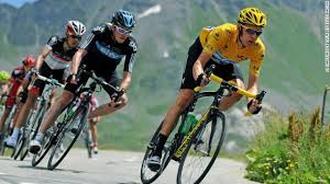
The beakaway group is upon us. Half a dozen riders, none of whom will figure in the final stage placings, race past in a couple of seconds. Another pause. The peloton appears on the bend, and speeds towards us. We see Bradley Wiggins and Chris Froome and cheer them on, but their focus is total. The concentration, the power, the speed is remarkable. And before one can find the camera app on the iPhone, they are gone. For St Quentin la Poterie, the Tour de France is over – probably for many years.

But for the St Quentinoises, it’s only just begun. More meat goes on the barbecue, more bottles are opened, more conversations with total strangers are initiated. It is a jour férié, after all, and tomorrow is Sunday, a day of rest. We’ll maybe wander into Uzès for lunch and – who knows? - I might write a blog about the events of the last couple of days.

Thought for the day: Joy Harper, who would have been with us for these events but who is currently in hospital in Nimes. I tried to give blood on Friday morning as a gesture of support but was refused because I was in England during the mad cow crisis. Instead, we have toasted often and are thinking of her always. Get well soon, Joy.


I’ve been back in the UK for a couple of weeks, where the conversation was dominated by bankers, tennis and the weather. Bob Diamond and Andy Murray both failed at the final hurdle; the one a cause for celebration, the other for commiseration. Murray will get another chance. One trusts that Diamond will not.

Of course, while I was away I kept in regular touch with events in the Uzège, and ensured the continuation of  cultural connections with the arrival on my Kindle app of the new book by Professor R.I. Moore. The War on Heresy: Faith and power in medieval Europe overturns much of what I had taken for granted about the dualist religions and philosophies collected under the catch-all title of Catharism, and one of the reasons why I took the received wisdom for granted was that historians such as Professor Moore had convinced me of it. He has changed his mind, and changed mine, not least by returning to primary sources and taking us back not merely to the 12th century but to 1022 and the first burnings in Western Europe in Orléans.

In fact, it appears, theological dualism, particularly in the Midi, was largely the creation of the inquisitors. The majority of Albigensians/Cathars/Manicheans et al were merely attempting a more ascetic way of life, of poverty and purity, more in keeping with their perception of the life of Christ, and with the thrust of the Gregorian reforms of the Church itself. In parallel, we also have the influence of Greek philosophy and in particular Plato, who argued that what is material is by definition transient and corruptible.

One can see how this can be characterised as a (potential) form of dualism, and how it might be developed into  a dualist philosophy. As Moore points out, “neoplatonists might deny that the Holy Spirit was contained in the water of baptism, or conveyed by the hands of the priest in blessing … without necessarily denying the sacraments themselves”. But is clear that the logical conclusion of this kind of thinking is the adoption of celibacy and vegetarianism, the denial of the pleasures of the flesh, which the bons hommes espoused and which distinguished them from their Catholic cousins, who certainly eschewed  poverty and to a large extent purity. (The side issue of Donatism, which argued that the efficacy of the communion was measured according to the moral rectitude of the priest, was a very specific danger indeed.)

In short, there was no sudden uprearing of heresy in the Midi in the 12th century. There was a great number of different strands of thought, all of which posed a threat – real or imagined – to the Church and the Vatican at a time when popes were looking to become monarchs and to win the battle with the eastern Churches. Dualism, an Eastern concept familiar to all students of theology, was a convenient scapegoat. The lifestyle of the so-called heretics was actually Christian, and exemplarily so. But dualism was a heresy and as such could be justifiably be used as a pretext for the Albigensian crusades.

And it is the success of that imperialist war which is the reason why I am writing this blog in France rather than L’Occitanie.

Today’s listening: Schubert’s String Quartet No 15, in G major by the New Orford Quartet, recommended to me by Peter Mendell last night. He is a friend of this excellent Canadian ensemble and also, I am proud to say, of mine.


Picture
Catalan music in the place Dampmartin
On World Music Day, one faites de la musique at the fêtes de la musique. (It’s a French homophone.)

The idea of a music festival to mark the summer solstice began in France, and although it has now spread throughout the world, France still takes it pretty seriously. Which is to say, with a complete lack of seriousness as every generation comes out to eat a special menu de la fête (usually moules frites), drink even more than normal, and enjoy a variety of music, good and bad. Uzès, famous for its Nuits Musicales featuring Bach, Vivaldi, Purcel, Gabrieli et al, throws itself wholeheartedly into this slightly different musical activity.

Last night, we were in town to take part in the festivities, meeting up with Nick and Anthea in the Bistro d’Uzès – a gastronomic rather than musical choice, because the band playing between the Bistro and the Suisse were Catalonian. Nick, an occasional jazz musician, pointed out that the rhythms were those of Latin jazz, but I’m afraid a little of this faux flamenco goes a long way as far as I’m concerned.

So, having enjoyed a good meal, and a very good demi or two of Chateau Mas Neuf, a Costières de Nîmes wine which used to be on the list at Wilde’s and probably should be still, we set off to make the circuit of world music.

In the Place aux Herbes, the real deal flamenco was playing, complete with dancers. At the Logis des Arts, a jazz combo. Outside Vin sur Vin was Dom Ryder, a multi-lingual jack-of-all trades who resembles a Grateful dead roadie. By Bar Fontaine was a band of elderly musicians performing Rat Pack classics, complete with Nelson Riddle orchestration and enticing even more elderly couples onto the street to dance cheek to cheek. At the Esplanade, it was down with the kids, with a cool dude working hard on the decks. We ended up at the Café Mouscade, more because a table suddenly became available than for the music, but were entertained by a very competent and professional rock-pop band with an excellent vocalist and impressive lead guitarist.

By 11.30-ish, we were ready for our beds. Jill and I strolled back down the boulevard Gambetta towards the car park, pausing for a while to watch an impromptu display of break-dancing  outside the Lycée.

The kids were brilliant, giving us the perfect end to the evening. After all, "All we need is music, sweet music/There'll be music everywhere/There'll be swingin', swayin',and records playin,/Dancin' in the street.

There was music everywhere. There was swingin' and swayin' (not all in time to the music and not all because of the music) and records playin'. And a great night was had by all.

Today’s listening: The Grateful Dead, Dancin in the Street. Plus, from Little Feat, some “country with a boogie beat”.

Picture
Rock n Roll at the Cafe Mouscade
Picture
Dancin' in the street, outside the lycee
 
 
Picture
Tom with Chef Bocuse.
Tom Barrett is an exceptional young man, and I would say this even were he not a friend. But he is and has been since he started part-time work at Wilde’s as a young KP and pot-washer ten years or so ago, earning a little pocket money on the side. That was then. Yesterday, we ate with him at the award-winning, Michelin-starred Le Jardin des Sens in Montpellier, where he is now the Demi Chef du Partie sur la Viande. It was a wonderful personal and gastronomic experience, enhanced by Tom’s presence at the table rather than in the kitchen.

Le Jardin des Sens is a modernist glass cube set in beautiful Mediterranean gardens. It is not cheap: on the carte, even a single starter can cost up to €77, but the Menu Déjeuner is a more modest €49, and it includes a glass of wine chosen for you by the sommelier. Well, it’s a start, I thought.

We met Tom, his mother and step-father and two new chums Roz and Aidan in the gardens. A glass of champagne, a couple of pig’s trotter fritters and an anchoïade of tuna and tomato later, we were ready to ease ourselves into the spectacular glass dining room. It is a beautiful space, comfortably accommodating 80 covers (it was full on a Tuesday lunchtime). Our large round table was immaculately presented, as were the waiting staff and the sommelier, who introduced us to a delicious Minervois red, an English source for which I have already found. Que Sera Serra from Villa Serra is one of the new breed from this region: light, slightly spicy, but with real structure. It went extremely well with my starter of soup and my main course of slow cooked cod.

Soup and cod. The food doesn’t sound too exciting, does it? OK, here’s what these dishes really were.

The starter: La barigoule de petits artichauts et légumes de saison servie froide, sorbet tomate, croustillant de gambas, huile d’olive et basilic. The distilled essence of the south of France, every mouthful an intense and different experience.

The main: Le filet de petit cabillaud cuit longuement au four en croûte de tomate, côtes et verts de blettes à la niçoise et en rissoles, mousserons dans leur jus de cuisson en émulsion. Exquisite – and witty, too, because what at first sight was the skin of the fish was in fact a fine layer of tomato. I’m a meat-eater, but this piece of fish was a taste sensation which will stay with me for years.

The desserts, and les gourmandises. I seldom do desserts, but yesterday I stuffed myself on some of the most wonderful patisserie you can imagine. I met Jean-Christian, the chef patissier who created them, moments later because Tom had arranged for us to visit the kitchens and meet his colleagues after the meal.

It was a pleasure in so many respects. But principally, it was a pleasure to see the respect and affection of the French brigade for le rosbif. He has earned this respect by working hard to meet the exacting standards of a French Michelin-starred restaurant. He works long hours. He speaks French fluently. He is still recognisably the schoolboy who started at Wilde’s, but he is a young man who understands that great food is the result of hard work and meticulous attention to detail.

It made us proud to know him.

Today’s listening: The Airplane from The Matrix in ’68 as I walk into Uzès for the food market: "Fly Jefferson Airplane, gets you there on time ...".


Picture
Home!
In common with thousands of other tourists, we used to pass the village of Mornas every year as we raced  down the Autoroute de Soleil on our way to Grasse, Cogolin or St Tropez. The imposing ruins of the medieval fortress towered above the autoroute to our left, and each year we would promise ourselves that, one day, we would search out the village and explore it. Of course, we never did. With three or four young children in the back, the priority was to find our rented villa, exchange jeans for shorts, and open a bottle of chilled rosé.

Then, in May five years or so ago, Jill and I were attempting a (spurious) short cut from Bollène to St Quentin, and – serendipitously – drove into this delightful village, which is built at the foot on the huge cliff on which the fortress was built. It being midday, we stopped, parked and found our way to Le Manoir, a Logis de France, where we enjoyed a quite superb lunch on the terrace. I can still remember the first mouthful of my truffle omelette.

Since then, lunch in Mornas has been the traditional curtain-raiser to our summer in the south of France (although this year, there is an argument to be made for that glass of Savigny Les Beaunes 2008 in Beaune itself!) The prix fixe menu this year was as good as ever, the demi of local rosé as refreshing as ever, and the service as friendly as ever. It is the perfect introduction to the south, and leaves us with merely a half hour drive through Pont St Esprit before we arrive in St Quentin la Poterie itself and set about airing, dusting and cleaning our small village house which has survived another winter intact.

This morning is the fifth day of our stay. The sun is in the courtyard. It is 21 degrees at the moment, and it promises to be 26 this afternoon. Which will do very nicely, merci.

We have done a great deal in less than a week. The house is once again a home. We have finished some unfinished work. We have caught up with old friends. We have visited our first  market in St Quentin and our second the larger one in Uzès. We have discovered that Momo’s has been taken over by the guys from Le P’tit Café, one of our favourite restaurants in Uzès, so my first salade gourmande of the summer was eaten within a 100 metre walk of home. This is good news, although the eclectic buzz of Momo’s cannot be replaced and is much missed.

Yesterday, we attended our first concert of the year. The fixed point of the second Sunday of the month is, in the winter, the performance of The Swaps at The Somerville. Last night, by way of contrast, it was the choirs of Languedoc-Roussillon and the Uzège performing Fauré’s Requiem, together with songs by Saint-Saëns, Hindemith, Milhaud and Tchaikovski, in the Temple d’Uzès, the Protestant church. These amateur choirs acquitted themselves very well, but the moment the professional soloists stood and sang, one knew that these were exceptional voices.  Soprano Raphaële Andrie and baritone Alain Iltis made my day, and even being swept by the Nationals at Fenway could not depress my spirits. (Although an apprehension that the Front National may have won the Gard in yesterday’s elections does.)

So: plus ça change, plus c’est la même chose. We are already immersed in la vie française. But this evening, whether we like it or not, we will be forced to be English again. It is England v France, and we plan to watch the game with a pichet or two in the Café de France.

Let's hope the entente can stay cordiale.

Today’s listening: The Ravel String Quartet. Just came on the iPod by chance. So beautiful.

Picture
The Chorale Encantarello d'Uzes takes the applause.
 
 
Picture
Where's my iPad? Illustration by Lara Voce (www.laravoce.com)

I'm writing this on a packed flight from Nimes to Luton, or London Luton as Ryanair calls it, after a surprisingly productive week in St Quentin. The plan was to do some work without distractions, and, on balance, it worked. But not completely so, because I encountered many distractions and - you will not be surprised to learn - several of them proved singularly difficult to resist.

The first distraction is St Quentin itself, which is unchanged from when we left it last October. Or is it? Actually, it only appears unchanged, because much has gone under the surface while we've been away. Fred has taken over behind the comptoir at the Bar du Marché, and Magalie is cooking up a storm in the kitchen; to the extent that they are serving more covers on a January Monday lunchtime than was previously achieved on an August market day. I hope they've got their sums right, because their food is very generously portioned and of excellent quality.

Meanwhile, down at Le Marina, Momo is rumoured to be passing on the baton to Xavier, the chef, and the mot on the rue is that a total refurbishment is taking place behind the closed doors of the restaurant, with Xavier planning an 'up-market' menu to compete with, or perhaps complement, the carte at the Bar du Marché.

In fact, it appears that St Quentin has renewed aspirations on a number of levels: the Bio boulangerie is being converted into no less than five new shops, we now have our own bouquinerie, and the commune has just acquired the ugly old wine warehouse outside which Ch'ti, the mobile friterie, plies its trade. The details of the new development will be announced soon. Watch this space.

Things are also on the move in Uzès. Paola and Olivier have re-branded Au Fils de l'Eau into Le Bistrot du Duché, with a more Bistrot-style menu which I didn't get a chance to try, and the Parisienne couple have now taken over from Thierry at Du Chai dUzès in the Passage des Marchands. I spent my last hour in Uzès in their company, discussing and drinking their new wines (which include La Gramiere!)and being reassured that oysters are still available at le weekend.

All these things and the gossip about them were distracting, but not so much so that my work fell too far behind schedule. No, the big distraction is friends.

It would be invidious to name names, so I will mention in this despatch only the following: Archie, Linda, Dianne, Parn, Joan and Joy. That's just the Brits and the Estonians. If, at some time in the future, an editor calls me for missing the deadline, you will be to blame.

Lunch was excellent - all of them. Coffee-into-pastis-into-wine breaks were brilliant. Aperos were great. The conversation, the wit, the humour, the erudition, the goss - they were all the most wonderful distractions. Thanks, guys.

For all the beauty of Uzès and the charm of St Quentin, this is actually why Jill and I love this part of the world so much.

It's all about friends. A bientot.

A reminder for this first 2012 lettre d’Uzès. As you know, the original Lettres d'Uzès were sent by Jean Racine during 1661 and 1662 to his friends in Paris. Racine had been sent to Uzès by his family to stay with his uncle, the Vicar-General. The hope and expectation was that, away from Paris, he would put poetry aside and embrace the priesthood. He never did, succumbing inevitably to the life of a town where “one bookseller starves as a score of traiteurs flourish”. These 21st century letters bear no resemblance to those of Racine, but are nonetheless dedicated to him - with respect, admiration and a thousand apologies.

Today's listening: Without the distraction of television, I've listened to some great stuff over the last week - from the Dead to Debussy. But right now, on my Ryanair flight, through my headphones, I'm listening to some outtakes from Dylan's Real Live album, with Mick Taylor on guitar. As ever with Bob, one wonders why some of these tracks never made the final cut (and why some that did, did!).


The UK welcomed us back with warm weather and a broken, leaking boiler. Parallel lives, you might say. There’s a mountain of post to sort through; plumbers to track down and tie down; parent, children and grand-child to see; friends to meet; wine bars to visit.

Yes, we’re back in the UK, so technically this is the first of the Leamington Letters rather than the last of the 2011 Lettres d’Uzès. But on this first anniversary of my blog, I’m looking back over the summer rather than forward to the winter. I want to stay in those moments – what Wordsworth called “spots of time” – for as long as possible.

It was, by any standards, a good summer. We met some wonderful new people and, I hope, made good and lasting friendships. We got involved in the vendange for the first time, and loved every moment of the work and the comradeship, which culminated in the Picker’s Party at La Gramière ten days ago. Our boot on the journey home was laden with samples from this excellent, garagiste domaine and a glass of their 2007 Syrah will remind me, on cold winter evenings, of our summer days. We spent some time with Cap’n James Walker on his boat on the Canal du Midi and we stayed at La Colombe d’Or. We played host to the children and their partners and to little Max, who arrived in St Quentin la Poterie a baby and left a toddler. (I saw him this morning and he is now a sprinter!)

In between visits and lunches and harvests, Jill painted some fine paintings and I wrote several thousand words of indeterminate quality. I also, of course, as many of you will be aware, established a blogging routine. My first ever post was a year ago today, and was read by fewer than a dozen people. There are now close to a thousand of you visiting this site each month. Thanks.

We left St Quentin with reluctance, turning north for the first time in months. There had not been the usual epiphany that it was time to leave. We found ourselves talking of “returning to the UK” rather than “going home”. And we had an endless succession of final occasions: the last market, the last oysters and Picpoul, the last salade gourmande, the last pastis. (There were several of these as I recall.)

But the north-bound journey had its compensations. We spent a delightful evening chez Bevan in Burgundy and drank an excellent Maconnais white as an apéro. It was gratifying that Neil and Janet admired the two bottles of La Gramière which we brought with us:  their approval augurs well for the tastings arranged with a leading English wine merchant later this month. Even the ferry trip was a pleasure. I had not known that P&O now boast a Langan’s Brasserie on each boat. As an erstwhile habitué of the Stratton Street original, I was surprised at the quality of the service and the food. Not bad at all.

Oh, and Tom Conti was on the ferry. He sends his love.

Leamington Letters will start next week in one form or another. If you have been, thanks for reading and commenting during the summer.

Today’s listening: Grateful Dead, the complete re-mastered European Tour from 1972. This is going to take some time.