
every smith
  • MS: Max Smith's blog
  • History to the Defeated
  • every smith: independent creative consultants
  • Words: Max - a brief bio
  • Sites to see

Leamington Letters #61: Oz

4/12/2013

10 Comments

 
Picture
Like most cricket-loving Englishmen, I have an ambivalent relationship with Australia and Australians, especially at a time like this, when there is a Test series going on.

Back in the 60s, we had an invasion of Australian intellect and intellectuals. Richard Neville, editor of Oz, Clive James and the incomparable Germaine Greer, were crucial to the movement at the time, and their energy, smartness and engagement, were important - at least to me - in facing up to one or two bourgeois tendencies that I had inherited from my public school.

These days, I love the Australian earthiness, their drinking, their love of sport and what Dame Edna famously referred to as their “total lack of cultural distractions”.

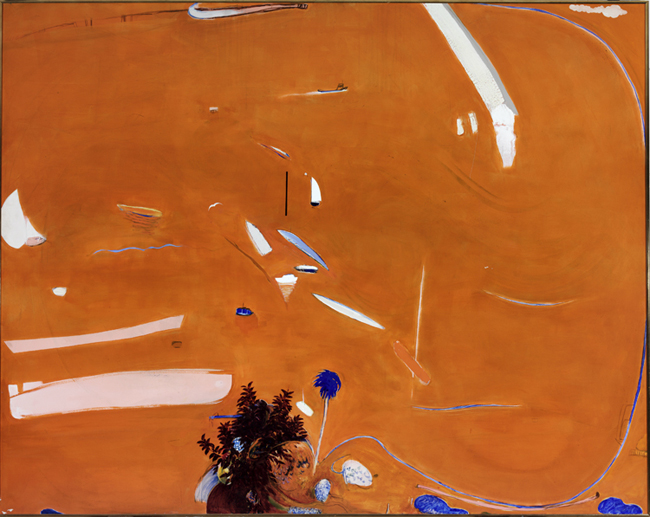
So, on our recent visit to London for Bob's return to the Royal Albert Hall, Jill and I found a couple of hours to see the Australia show at the Royal Academy.
Picture
It was a revelation.

Not, of course, for the colonial, imperialist, landscapes of the English painters, although some of the painting is more than competent and the subject matter fascinating.

The wondrousness of the show was all about the exquisite, obsessive, detailed and scale of the work of the native Australians.

Aboriginal art is both style and substance.

The style is decorative, reminding me of Arabian, Iranian, Turkish carpets, in which religious icons are combined with images of heritage, to create something which is greater and more universal than either.

Some contemporary Australians, of European heritage, have attempted to continue this tradition, and they have failed quite spectacularly.

Others, notably Sidney Nolan, have drawn on the landscape to create something as modern and as distinctively Australian as Wolf Blass Shiraz. Some are particularly successful in capturing the banality of Australia in the 50s, against which the three mentioned above rebelled and from which they escaped: Jeffery Smart, in particular, completely new to me, deserves a wider audience.

But, for the Europeans, the native technique is merely and only that, a technique. They seem to me to fail to understand that the medium is as much the message as ... well, the message. This is also the case in the work of the so-called Australian impressionists. It's ok, but it’s not quite there, is it? It may be Australian, but it's not impressionist. And when it is impressionist, it's not Australian.

There is no doubt, however, that it was an afternoon exceptionally well-spent, and well worth the annual cost of our Friends of the RA cards. 

With the exception of a load of where-the=hell-do-we-put-this? stuff in the final couple of rooms, it was moving, engaging, challenging and stimulating. We loved it.

And we also loved the new Keeper's House bar and restaurant. Under the aegis of Oliver Peyton and, during the day, open exclusively to Academicians and Friends, it is our very own club in Piccadilly. The Wolseley is just across the road, but, for once, we didn't visit. No need. The Keeper's House will do me very well indeed when I revisit the RA to see the Daumier on Paris exhibition in the new year.

So that's what we did before the Bob concert. Read the preceding blog for a review of the concert itself. My judgement may not be what you expect.

Meanwhile, because this was all happening the day before Thanksgiving, and I needed to be back in Leamington for Michelle's celebrations, I mused on the train about all the things for which I can give thanks this year.

For me, that means a second grandson, a first step-grandson, and the marriage of my second daughter Cassidy to a man I admire and respect and who is good for her.

And then, there was the World Series.

That's a good year by any standards.

Today from the everysmith vault: Wooden Ships from October 1991. Paul Kantner returns to his folk roots in the back room of McCabe's guitar shop in Santa Monica.It was just after the death of Bill Graham, and Paul recounts a conversation he had had earlier with Jerry. Very moving
10 Comments

Lettres d'Uzès #41: simple twists of fête

18/8/2013

11 Comments

 
Picture
Picture credit: St Quentin la Poterie
Sunday morning in St Quentin la Poterie. The hygienically pungent smell of disinfectant hovers in the streets. The tabac is busy with purchasers of extra cartons of cigarettes. Carrefour is the scene of manic buying, with the owners of Café de France and Le Cuisine du Boucher at the front of the two check-outs, loading up dozens of baguettes, salads and 5 litre bottles of Coke. In the Bar du Marché, opinion seems divided as to whether a simple café is sufficient to kick-start the day or whether to begin as one intends to continue with a beer or pastis.

Nous sommes en fête.

The fête votive started on Thursday evening and will continue unabated until the early hours of Tuesday morning. The bulls are run each evening. There are gigs every lunchtime, every evening and every night, often several competing against each other for an audience and decibel rating. 

The restaurants, even 30 Degrees Sud, put on a special menu du fête, which means that, last evening, we celebrated Nicole’s 50th birthday with moules frites rather than foie gras, and on Friday evening we snook out of the village to eat at Le Comptoir du 7 in Uzès with Michelle and James, finishing off with a final pichet in Le Bistrot du Duché as we waited for the late arrival of Cody.

But most of the time, unlike some, we are more than happy to stay in the village and soak it all up - literally so on occasion.

The fête is the commune-goes-mad. And it’s brilliant, especially if one can – as we can – dip in and out: a drink here, a gig there, a bull run here and a grand bal there. 

But of course, we are pretty much always en fête, or at least on holiday. We have no work commitments. We can, as we did earlier this week, just take off on a whim and head for Aix-en-Provence to visit the second half of Le Grand Atelier du Midi exhibition at the Musée Granet.
Picture
It was … better? perhaps not, but certainly more interesting, than the Marseille show. For a start, there are more Matisses and Cézannes, and fewer fillers from the second division. The quality of the work is more consistent and although it was a great deal busier than the Palais Longchamps in Marseille, it was a more enjoyable and more rewarding experience.

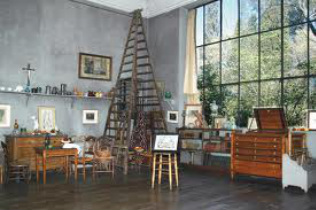
But it wasn’t the highlight of the week or even of the day. That was reserved for our visit to Cézanne’s studio, which he built just north of the cathedral in what was then an undeveloped landscape. Today, one walks up the hill past blocks of apartments and retirement homes to find the gate to this splendidly unrestored studio, with its huge north-facing window, and the collection of artifacts owned and painted by Cézanne.

To see the ingredients of his famous still life paintings, to see his suit, his stove, his pots and pans, his chair and table, was quite wondrous, and almost made me forget that our chosen restaurant had run out of the chef’s special rognons de veau by the time we sat down to eat. (Don't worry, the tartare was gorgeous.)

An excellent day, then. Followed the next morning by the arrival of chums from the UK, and the fête. Followed by Nicole's birthday. Followed by more of the fête.

On our return to the UK, which is imminent, it is the memory of these days, this light, these occasions, these happenings, which will help us through the winter.


Today from the everysmith vault: Paul Kanter, David Freiberg, Kathy Richardson aka Jefferson Starship playing in The Assembly, Leamington Spa back in 2009. Nearly four years ago now. A great gig - and this tape confirms that it was as good as I thought at the time.
11 Comments

Lettres d'Uzès #40: An(other) Essay on Criticism

13/8/2013

17 Comments

 
Picture
Alexander Pope, contemplating the nature of criticism
It has been suggested recently that I am, in these blogs, thinking of myself as a critic. I am not.

I am, on occasion, critical - of a wine, a book, a painting, a piece of music, a restaurant, a ball player. But that is not the same thing at all. The role of the critic is to be, not negative, but positive: to evaluate, to provide deep context, to establish relationships, to elucidate and enhance. In this sense, I suppose that from time to time I write within a critical tradition, but that is not my intention.

This is a blog, not an academic treatise. I allow myself half an hour and plus-or-minus 500 words for each post. The prompts are my reading and listening, my eating and drinking, my obsessions, my social activities. But as some of my excellent correspondents have pointed out, there is a theme developing from these disparate activities, of which – to be honest – I was not consciously aware.

This theme, it would appear, is the appreciation of all activities as a totality, as part of ‘life’ – a word which Leavis substituted for tradition and continuity. 

My subjects, whether they be a new Dylan album, a fine claret, an exhibition or a baseball game, are part of life and contribute to the fundamental ‘vitality’ which is ‘crucial’ to developing an individual ‘meaning of life’, the making of valid choices not through evasion but single-minded commitment.

If I had to categorise what a friend flatteringly characterised as ‘these essays’, I would use the word explorations, which is itself an important Leavis word, and as he said in another context, ‘all important words are dangerous’.

In this case, the danger comes from imposing an importance on my observations which they are incapable of bearing. And often, I confess, they are gut reactions rather than considered judgements.

In the tutored tastings at the Foire aux Vins, for example, I hated the sweetness of the whites, the oakiness of the reds. The maligned wine critics of my previous blog could doubtless explain and maybe even justify. For me, it is simply not to my taste.

Does this mean, therefore, that when you read this blog, you are merely the recipients of some undigested prejudices?

I promise you, you are not. Because more often than not, I start only with a topic. Over the course of the 500 words, I develop my approach and attitude and finally a judgement, a valuation. 

So in the average blog what you are reading is the record of a process of internal debate and argument, backed by Wordsworthian spots of time, structured in the form of  Judt’s Memory Chalet, supported by quotes from better writers, and concluding with … well, a sort of conclusion.

Bit like this one, really.

Today from the everysmith vault: Yesterday, of course, was the wonderful music of the test match commentary. Today, it’s the New Riders of the Purple Sage from July 1971. A 10 minute version of Dirty Business, with Jerry on pedal steel, is the highlight.

17 Comments

Lettres d'Uzès #38: Marseille - le vrai atelier du Midi

28/7/2013

11 Comments

 
Picture
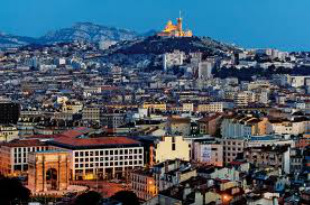
Marseille is tout feu, tout flamme about its independence, internationalism and sense of identity; its architecture, art and artisans; its radical past and its cultural present, its freedom-loving life and life-style.

After our first visit this week, so are we.

Marseille is the oldest city in France. It’s the second city of France. And it’s the home of pastis and bouillabaisse. It elected the first socialist maire in France in 1890. It was a refuge for Jews and a centre of resistance against the Nazis in the war. 

Oh, and it is also, in 2013, the European capital of culture.

It is, in fact, a méli-mélo of stereotypes. So Jill and I thought we’d check it out, using as our excuse and opportunity, the exhibition at the Musée des Beaux Arts, part of the Grand Atelier du Midi show, which focuses on works of artists from Van Gogh to Bonnard.

We took the TGV from Avignon, paused briefly in Aix-en-Provence, and arrived in Marseille in plenty of time for our pre-booked slot at the gallery. So much time, in fact, that we had checked in to our hotel, drank a half bottle of chilled rosé, eaten a small plate of charcuterie and courgettes, walked to the Palais Longchamps and enjoyed (most of) the paintings, even before our allocated time was scheduled to begin.

For the record, loved the Van Goghs, the Renoirs (always associated him exclusively with Paris), the Duffys, the Picasso, the Matisses, the Bacon, and some of the Bonnards;  loathed the Manguins, the Marquets and the Massons;  quite enjoyed the Paul Signac.

So by half three in the afternoon, we were free to explore Marseille. And we made a startling discovery: le vrai Grand Atelier du Midi is not the gallery and its contents, but the city of Marseille itself.
Picture
Picture credit: Foster + Partners
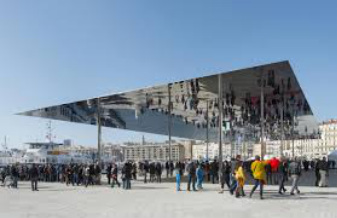
Like everyone, we headed first to the Vieux Port by jumping on a tram which took us silently and smoothly down the boulevard to the sea, where we were greeted by l’Ombrière, Norman Foster’s wonderfully simple, stylish and sleek sun shade. 

It’s both use and ornament (as my grandmother used to say): a shady events pavilion, a beautiful structure, and a place for reflection - literally and figuratively. 

Two views are better than one. 

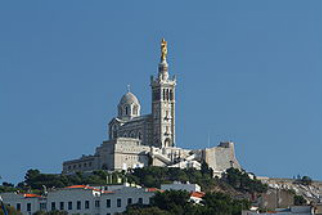
But there was another view which was already haunting us and it is ubiquitous wherever one walks. It is Notre dame de la Garde, which looks down on the city, and is regarded as a guardian and protector of the city. It's known by the Marseillaise as la bonne mère for this reason.

We took the advice of the guide-book and, rather than attempt the walk, squeezed ourselves aboard a tourist train, which took us along the Corniche (longest in the world apparently), gave us half an hour to admire the neo-Byzantine basilica and crypt, and delivered us back to the plethora of restaurants and bars which line the Vieux Port.
Picture
La Bonne Mère: guardian and protector
But we weren't quite ready for a drink yet. We wanted to plan the next day, ensuring that we could make the most of our visit.

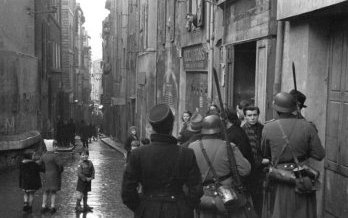
So we walked through Le Panier, the oldest part, where The French Connection was filmed, where the Jews hid, where the communists and resistance were based, and where the Nazis - together with a huge contingent of French police from Paris - evacuated 30,000 people, sent 2000 of them to concentration camps and dynamited 1500 houses. All in a single day in January 1943.
Picture
Picture credit: Wolfgang Vennemann for the German Federal Archive
We returned the following morning, walking through the tiny streets which remain, finding the poignant tributes to those who had died or disappeared, mourning the way in which this area is becoming embourgeoisified. There is even a brand new InterContinental Hotel here now. But enough remains to remind us of the feisty, Bohemian, freedom-loving community which had to be destroyed by the Nazis and the Vichy government.

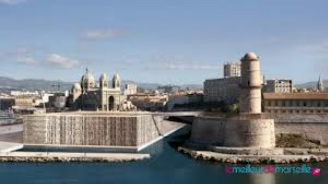
At the far side of Le Panier is the Fort St Jean. This, and the Fort St Nicolas, were built by French kings not so much to protect the city as to dominate it and ensure that its people knew their place.

Today, the Fort St Jean is linked by an elegant walkway across the sea to a wonderful new structure, designed and built as part of the Capital of Culture celebrations.

This is the Museum of Civilisations in Europe and the Mediterranean, or MuCEM, and it is beautiful. It links the land with the sea and it links France with North Africa. It captures the essence of Marseille: its trading, its Phoenician origins, its role as an entry point and a conduit for other cultures.
Picture
MuCEM, the fort, and (in the background) the Cathedral Le Mayor which we also visited that morning.
It is a beautifully designed atelier of Marseille's history, heritage, myth and contemporary life.

But the grand atelier is not MuCEM. Nor is it the Musée at Palais Longchamps. 

It is Marseille itself: the city and its people.
Picture
* You wouldn't expect me to write about a city without a reference to food. So:
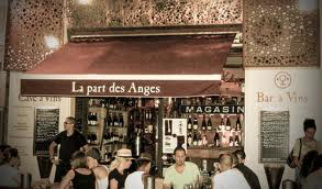
Where to eat: La Part des Anges, a bar à vin on rue Sainte, with 300 different wines and no wine list. Tell the waiters what you like and what you are going to eat, and they will bring you a glass of something wondrous - or maybe two or three or more. Brilliant place. Love it. 
Where not to eat: Pretty much anywhere in the tourist bit of the Vieux Port, but especially not at La Cuisine au Beurre.

Today's listening: Coupo Santo, the national anthem of Provence, which we heard sung at the end of a communal dinner in an adjoining village on Friday evening. A beautiful song, rendered tout feu, tout flamme, by many of those present.
11 Comments

Lettres d'Uzès #37: Le Grand Atelier du Vers

22/7/2013

11 Comments

 
Hier, vers dix heures, nous roulions vers Vers.

Vers is, of course, the commune in which stands the Pont du Gard, and from the quarries of which come the stone (pierre de Vers) from which the aqueduct is built. These days, it has added Pont du Gard as a suffix to its name, in case anyone forgets its intimate relationship with the third most popular tourist destination in France.

But the Pont du Gard was not the reason for our Sunday morning excursion. This weekend past, Vers celebrated its fifth annual Cours et Jardins des Arts event.
Picture
Le cours Berberian
The name says it all. The residents of this lovely village throw open their courtyards and gardens to exhibit a moveable feast of artworks, most of which is made by residents of the village or near neighbours.

There were 25 locations according to the map, and Jill and I worked our way through them all in numerical order. Yeh, I know, slightly OCD - but the trail was clearly marked with whitewashed arrows on the narrow streets and the beauty of this kind of event is that one never knows when one is going to encounter, in a small garden round the back of the olive tree, a work which makes you pause and give thought.

This happened to us a couple of times over the course of the morning, although the major highlights were those which we could have predicted at the start: Unity Cantwell’s work, about which I have written before; and the paintings and sculptures of M. and Mme. Berberian.

I guess Michel and Christelle Berberian are the golden couple of the artistic scene in Vers. His paintings are well-known, much admired and collected. You can see them and buy them from Saatchi. And you can see them on the walls of friends’ homes. But it was her sculptures which took my eye.

Her work – or at least the work she showed over the weekend – is on a small scale, but it is nevertheless solid and substantial. Heavy.

In most cases, the display did not allow one to circumnavigate a piece: one was forced to view it in a particular way and from a specific angle.

Did we therefore see exactly what the artist wanted us to see? Is the interaction between artwork and viewer, our point of view, being controlled in this way?

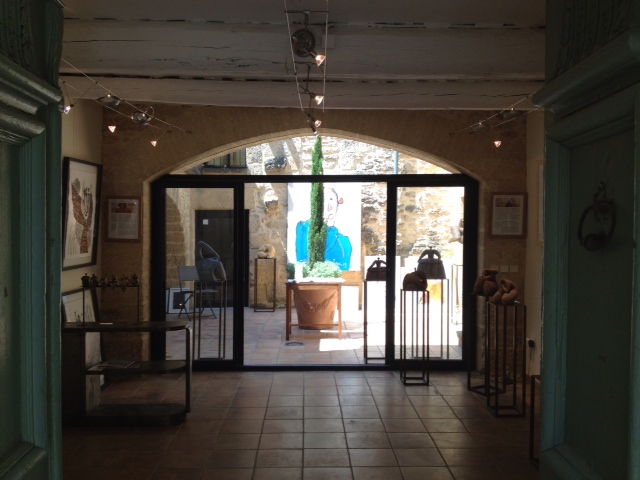
I don’t know. But I do know I like the work a great deal. And I propose to return to the Berberian’s gallery when we have time to look more closely at these exquisite but strong and sturdy figures.

What we won’t be able to see on our subsequent visit, of course, is the setting. One of the attractions of art displayed in courtyards and gardens is the access we are given to people’s homes.

We are as nosy as anyone. So we loved our glimpses of other people’s lives: the powerful abstract on the wall of a sitting room we passed through on the way to the rear courtyard, or the beautiful Provençal kitchen we enjoyed whilst pretending to admire a dreadful daub of a St Victoire style landscape.

Thanks to all those who exhibited and provided the exhibition space. 

We will be heading vers Vers again soon. But only after we’ve been to the Grand Atelier du Midi in Marseille …

Today from the everysmith vault: Dexter Gordon, One Flight Up. Long Tall Dexter was one of the best, and most under-rated, tenor sax players of all time. I like to think that my step-grandson, Dexter George Voce, has an affinity with this all star.

11 Comments

Lettres d’Uzès #32: Chelsea Girl

14/6/2013

13 Comments

 
Picture
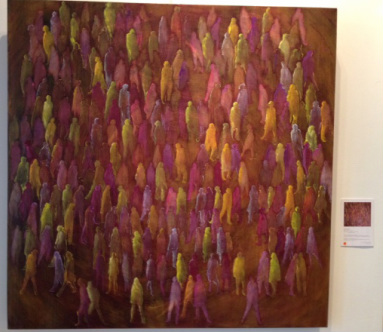
Your word for today is vernissage, literally the varnishing, but today applied to the opening party and preview for a new art exhibition. Last Friday, Jill and I joined four score or so art-lovers at Unity Cantwell’s vernissage  at the Espace des Capucines in Uzès.

The gallery was packed and the generosity of our hosts,together with the animation of our fellow-guests, made it difficult to examine the paintings in any detail, so it was only subsequently, over a number of visits, that we were able to look with a measure of tranquility and to engage with the work.

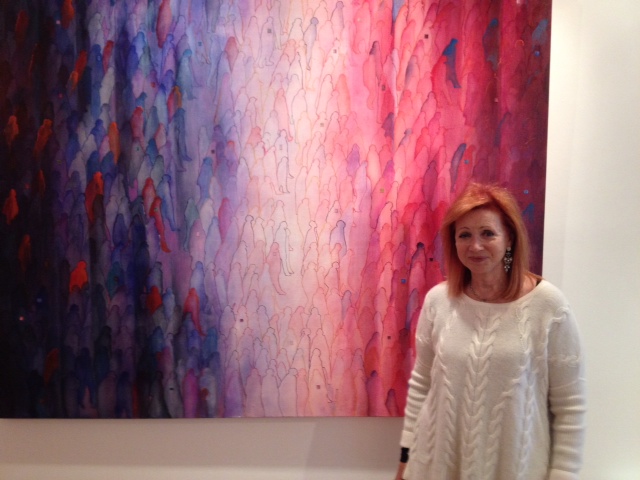
The exhibition is entitled Rencontres – meetings or encounters. At first sight, and from a distance, the paintings might be decorative, abstract patterns. In this sense, as I overheard someone say, they are ‘easy to live with’.

But look more closely and you see that those motifs are in fact figures – they are real people - and that what one is witnessing here is a series of encounters, of meetings. And what fascinated me was the imaginative creation of narratives to describe, explain and clarify the hundreds of individual interactions which make up each painting.
Picture
Rencontres
There is passion here; and there is indifference. There is embracing and avoidance. There is loneliness and sociability. There is sharing and selfishness. There are confrontations and retreats. There are chance meetings and appointments.

But each figure exists only in relation to the others: to its immediate neighbours and, through the group, to those more distanced, more separate.

In other words, each painting is proving that there is such a thing a society, that we are defined by the company we keep, that we celebrate our humanity in community, in companionship, in camaraderie.

Each painting is showing us that we are never completely isolated, that ‘no man is an island’.

Each painting is portraying us, each of us, as one element in series of connections which are both general and particular. As one drills down to the specific figures, one appreciates that, if  ‘to particularize is the alone distinction of merit’, then Unity has achieved this.

But she has also forced us to consider wider and more universal questions about our position and role as members of humankind.

Rencontres closes on the 19 of June. If you are anywhere near the Gard, I commend it to you.If you can't, check out Unity's website: www.unity4art.com. 

Today's listening: with Jill back in the UK visiting her new grandson, I have been able to check out some of the less travelled items in my collection. Today, it's MC5.

13 Comments

Leamington letters #48: The tradition of the new?

9/5/2013

16 Comments

 
Picture
Lord Acton: "the magistrate of history"
I heard on the radio yesterday morning that the Queen’s speech is read from sheets of goats’ vellum, and that the ink with which the speech is written takes three days to dry. And I remembered that the conclusions of Vatican II, the modernising ‘reforms’ of the Church under Pope John XXIII, were published in Latin.

If the medium is the message, we’re in serious trouble.

Which is not to say that I believe tradition and modernity to be polar opposites. I can understand why some may believe that tradition is a catch-all word for all that they despise, that a reference to tradition is a means of bestowing an illusion of permanence on a policy, an ideology, or anything which is transient or contingent.

But if I believe in anything, I believe in history. And, as Henry James pointed out, “it takes an endless amount of history to make even a little tradition”.

It is difficult to mention even a little tradition without prefixing the word with the qualifying phrase, ‘time-honoured’.

Is it so? Is tradition time-honoured? Or is it merely ‘time-worn’?

There is some truth in the statement that tradition only becomes tradition when it is, effectively, dead; when it is finished as a progressive force. But I am not clear (as my friend Rick Gekoski would say) whether this is useful when comparing it with modernity, or its cousins modernism and post-modernism.

Bob Dylan, for example, was and is an exemplar of modernity and modernism. But as Michael Gray has pointed out, he works most successfully within the tradition of the pre-war blues. He recreates, re-interprets, re-invents the genre for us. In  approach and attitude, tonality and structure, our greatest modern poets – Eliot and Auden - have worked within a tradition, the Metaphysical, which was established centuries before. And Wordsworth and Coleridge, revolutionary in politics and poetry at the time they composed Lyrical Ballads as both of book of verse and a manifesto, were working within a long-established tradition of the ballad. I will leave it to my commentators - Geoff, Chris, Charlotte and Ken - to point with accuracy to parallels in the world of art.

We are not dealing with opposites at each end of some linear progression. Modernity, in reacting against a tradition, continues that tradition, re-forming it and thus creating a new tradition against which a new generation can respond, react and renew.

It is a continual and continuing process, and is thus – in my view – time-honoured. If the tradition is worthy, it gains new life. Otherwise, it has no validity, no attraction, and it dies.

So why is the Queen still reading from goats’ vellum? Come to that, why is the Queen still reading a speech at all?  And why is all this  arcane Black Rod nonsense still going on?

Well, there may perhaps be some truth in another of Lord Acton’s aphorisms: that the authority of tradition serves as a restraint on absolute power.

If only …

Today's listening: correspondence between Rick Gekoski and Kazuo Ishiguro as to whether Dylan's 'lost' song I'm Not There (1956) should qualify for inclusion in Rick's book Lost, Stolen or Shredded has prompted me to return to the complete Basement Tapes and that sublime song in its original, one take version.

16 Comments

Leamington Letters #41: Whither goest thou?

11/3/2013

7 Comments

 
Picture
Gareth Brynmor John
How was your week-end? We had a great time, thank you. We went to London. 

My nephew Gareth was singing at the Wigmore Hall and his grandmother was coming down to see and hear him and meet up with other family members at a Mothering Sunday lunch before the gig.

Jill and I used the opportunity to do a number of things which we had left undone: in other words, wine tastings, restaurant meals, and gallery visits.

We started at the home of Karl Marx in Dean Street. This is now, and has been since the year of the General Strike, a restaurant called Quo Vadis. It is, in a familiar phrase, something of a Soho institution, and has had its gastronomic ups and downs over the years, but has reinvented itself in the last 12 months by giving a free hand to Chef Jeremy Lee, who was poached from the Blueprint.

The food is a sensational combination of technical accomplishment and no nonsense. I indulged recklessly with a starter of rabbit livers and a main of ox liver – both sublime. But the highlight was Jill’s hare pie: not a ramekin with a puff pastry top, but a pudding bowl with real pastry, and inside, a huge quantity of the most delicious jugged hare. Jill allowed me only a single tasting mouthful, but it was enough to make me regret my organic choice, although not the choice of restaurant. Quo Vadis is first-class, even down to the half bottles on the wine list (such circumspection necessary because we had sampled apéros at Vinoteca on Beak Street on the way and I had a wine tasting at Berry Brothers in St James scheduled for later in the afternoon).

Picture
In short, a great start.

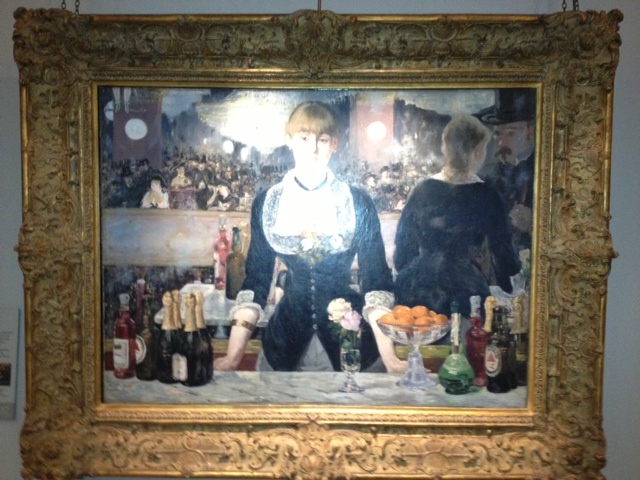
And the weekend continued in the same vein. The Manet exhibition at the Royal Academy, a tasting of 2011 Rhones at BBR, the early Picasso exhibition at the Courtauld, and an extraordinary show of paintings of Cornish fishermen at No 2 Temple Place, a late Victorian arts and crafts house on Embankment, which belonged to the Astors in the ‘20s, and now restored is worth a visit even if there is no exhibition on display. The Picasso was under-whelming, serving to illustrate how derivative was the 20 year old; but the Courtauld also has in its permanent exhibition many of those iconic paintings which one knows so well but, in my case, had never actually seen before. Degas, Van Gogh, Cezanne, Manet, Monet, Renoir … each room, each wall, is a surprise, a delight, an education.

But the highlight of the weekend, surely, was the Wigmore Hall on Sunday afternoon. My sister’s boy Gareth Brynmor John was the choral scholar at St John’s Cambridge and is currently at the Royal Academy of Music, where he is completing the Opera course whilst forging a serious reputation in the musical world and winning countless competitions.

On Sunday, he performed a great deal of Britten, and a little of Britten usually goes a long way.

But yesterday, Britten’s settings of Songs and Proverbs of William Blake did not go far enough. The power of Gareth’s voice, combined with the ability to convey the subtlest of nuances of meaning and emphasis, bestowing gravitas even where there was none originally, made us want for more. 

And I will long remember the beauty, in the setting of the Tyger, of that final couplet:

What immortal hand or eye
Dare frame they fearful symmetry?


Today's listening: It should be Britten, I guess, but thanks to links from Rick Hough in Boston and Michael Gray in the south of France, it's ABB - the Allman Brothers Band.


7 Comments

Leamington Letters ≠38: from the Duke of York's HQ to the Duke of York's Theatre

19/1/2013

21 Comments

 
Picture
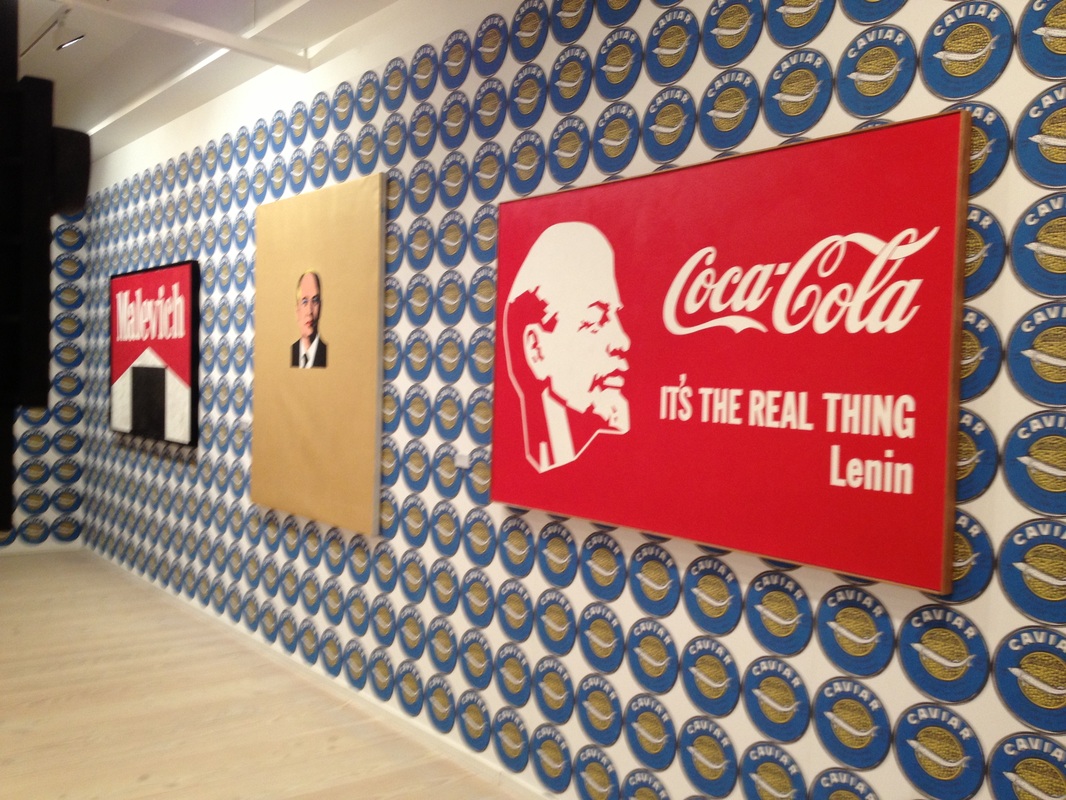
It is somehow appropriate that the Saatchi Gallery should host an exhibition of Soviet and Russian modern art. Set in the imposing space of the Duke of York’s HQ in Chelsea, the gallery established by one of the major beneficiaries of Thatcherism and global capitalism is currently showing two very different but contiguous exhibitions of work from the first three decades of Moscow-based, post-Stalinist modern art.

What is interesting is the paucity of ideas from those who looked to mimic the west, and the accomplishment of those who wished to engage with Stalinist and socialist (they are different) realism in a modern, political and creative manner.

Picture
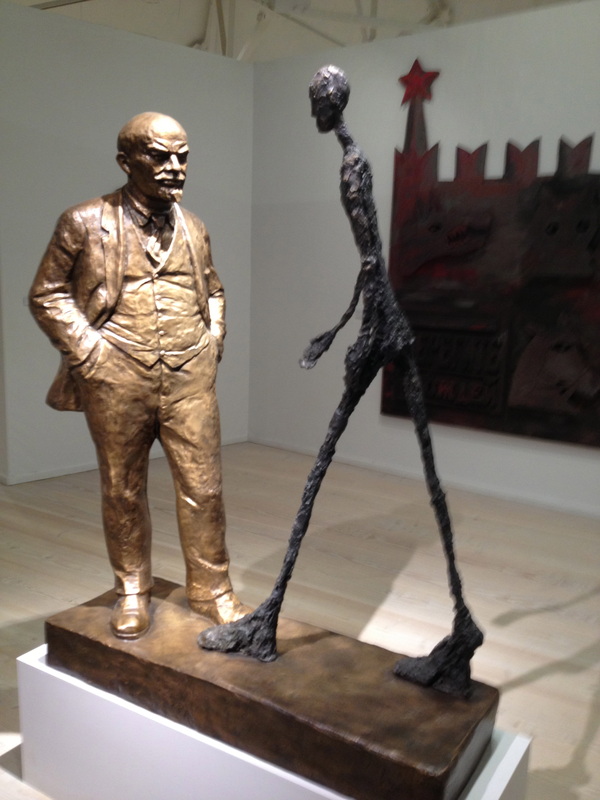
So the highlights for me were the mocking works of the Soks Art movement, which draw on pop art and socialist realism, and the nostalgic socialist realist works of which the Meeting of Two Sculptures above, by Leonid Sokov, is a favourite, as Lenin peers at a faux Giacometti.

In a single piece, we see the clash of cultures, the struggle between what is permitted and what is forbidden, the synthesis of old and new left.

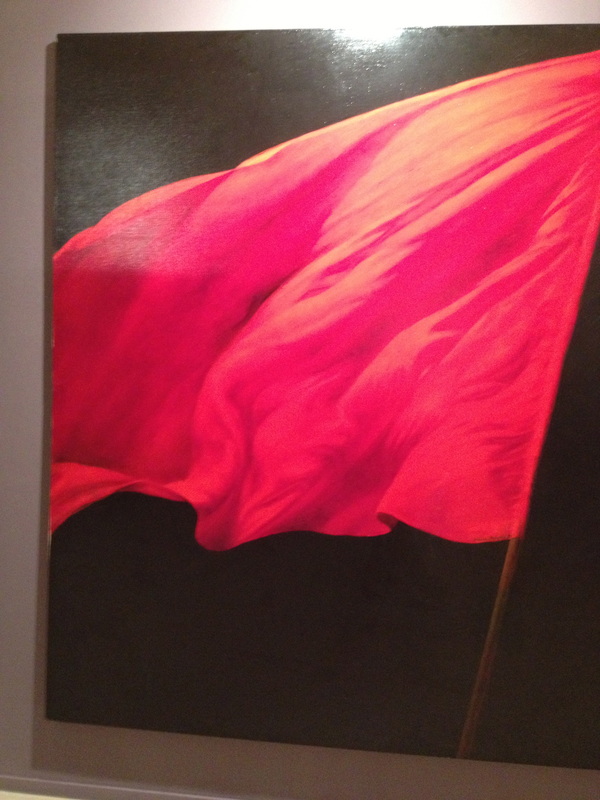
This is art. This, below, is an easy, cheap, advertising idea.
Picture
Well, ok. But to quote Lenin legitimately, it is one step forward, two steps back.

One understands why it might have been conceived, even executed. But one fails to understand why the image sits on a wall in a gallery in London. 

It's glib and it's facile, and it is a matter of concern that this kind of western icon has been appropriated by the new Russia and its non-conformist artists. 

It's a mystery why the curators of the Saatchi Gallery believe it worthy of our attention and their very expensive wall space, unless it is to celebrate the ways in which an ex-communist state can so easily be absorbed into our own business of art.

It is from one form of conforming to another.

We spent the morning at the Duke of York's HQ. That evening, we were at the Duke of York's Theatre to see The Judas Kiss, David Hare's play about Wilde.

It was always a good play. But now, in this revival, with Rupert Everett as Wilde and Freddie Fox as Bosie, it is something of a triumph.

In this script, and in this performance, one sees both sides of Wilde: a man who will not compromise his moral integrity, and a man who is hell-bent on self-destructive martyrdom.

In the second half, he is a shrunken figure, but a brave and determined figure, whose wit and intelligence remain despite knowledge of his imminent betrayal.

The theatre is old and cold; the noise of the underground reverberates regularly. But the play is profound and cathartic. I commend it to you.

Today's listening: Miss Sold from the Swaps. We all know that this is a great live band, but they can do it in the studio, too. 
21 Comments

Lettres d’Uzès #28: Dark illumination

20/9/2012

2 Comments

 
Picture
More informed: Professor Callen

The story goes that a High Court judge, exasperated by a line of questioning from FE Smith, told the barrister that having heard the evidence, he was “none the wiser”.

“No, my lord” replied Smith, “but far better informed”.

I was reminded of this watching our friend Anthea Callen on Fake or Fortune?, a BBC TV programme which follows the progress of authenticating works of art. This week featured Degas, one of Anthea’s specialist subjects.

Of course, the point of the programme is to pronounce the picture genuine and thus turn a painting worth a few hundred into something which the owner can sell for hundreds of thousands, so any perceived reluctance is a potential issue for Fiona Bruce, the ubiquitous presenter. So when Anthea refused to give an unconditional guarantee, Bruce told her that “connoisseurship is an opinion, and there will be several opinions.”

I will treasure Anthea’s response for some time. “Of course” she said. “But some people are more informed than others.”

For my part, I didn’t think it was a particularly good painting, certainly not as good as that of which it was possibly a copy or a precursor. But one of the issues I have with the art market is that a painting is good or bad, worthless or priceless, according to its maker.

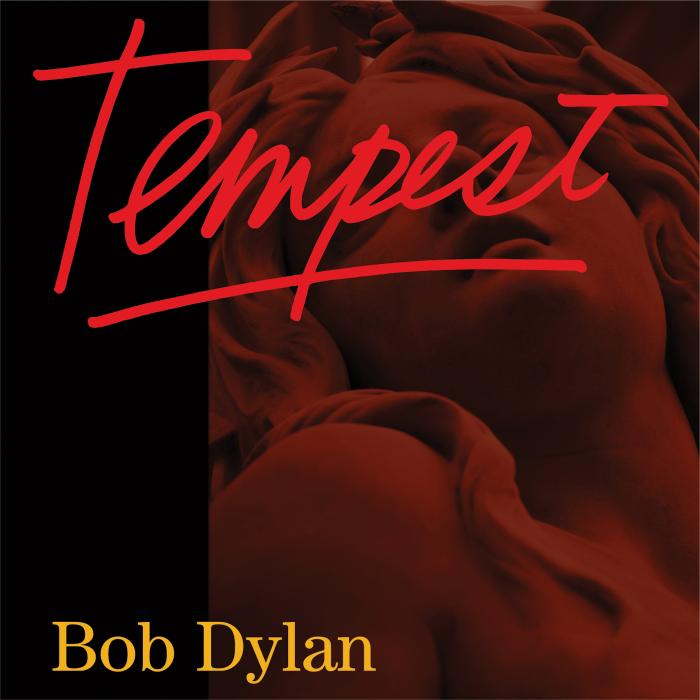
It doesn’t work in other fields. As I listen once again to Tempest, I reflect that Bob’s authorship does not bestow greatness per se. He has written some spectacularly bad songs in his time, and they are no better because he wrote them. Tempest received pretty much unanimous praise from the reviewers, much of it based on a single sneak preview, and much of it influenced by one of the most intensive marketing campaigns for any Dylan release.

There has been no shortage of phrases to sing his praises.

But like Anthea and her Degas, I have not rushed to judgement. I have now spent two weeks with Tempest. And I am finally ready to confirm that this is an extraordinary album. But not without flaw.

I am, for example, skipping the first and final tracks on most plays. The first is a good song, but is out of kilter with the rest of the album. The lyrics are by Robert Hunter, and would be more appropriate for the other Bob, Weir, in his cowboy mode. The final song is certainly a “heartfelt tribute”, but so was my bursting into tears when I heard of John’s death: heartfelt but not art.

The core of the album, however, from Soon After Midnight through to the title track, is uniformly magnificent and uniformly dark. If it was once “not dark yet”, it certainly is now. His epic narratives are now populated with “flat-chested junkie whores”, corrupt financiers and politicians. They are punctuated with lines of Brechtian viciousness. In no song is there any sense of redemption. It is remorselessly bleak. Everything is broken.

As he sings in Early Roman Kings: “I can strip you of life/strip you of breath/ship you down/to the house of death.”

In the “dark illumination” of this album, Bob has shipped us down to a Desolation Row for our times, and it is a morbid and frightening experience to which we will return again and again.

Today’s listening: Still Tempest, but this morning paying particular attention to the excellence of Tony Garnier, whose upright bass is masterly and (rightfully) prominent throughout.

Picture
2 Comments
<<Previous
Forward>>
    Picture

     Max Smith

    European writer, radical, restaurateur and Red Sox fan. 70-something husband, father, step-father, and grandfather. Resident in Warwick, England.

    Picture
    Picture
    Picture

    RSS Feed

    Categories

    All
    Art
    Baseball
    Books
    Film
    Food + Drink
    French Letters
    Leamington Letters
    Media
    Music
    People
    Personal
    Politics
    Sport