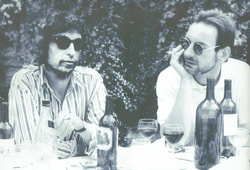

Today's listening: It ought to be John Cage, but 4'33" is a long time. And as Chris pointed out, which version? So I'm playing Love Minus Zero/No Limit because my love, she speaks like ...
 
 
It is somehow appropriate that the Saatchi Gallery should host an exhibition of Soviet and Russian modern art. Set in the imposing space of the Duke of York’s HQ in Chelsea, the gallery established by one of the major beneficiaries of Thatcherism and global capitalism is currently showing two very different but contiguous exhibitions of work from the first three decades of Moscow-based, post-Stalinist modern art.

What is interesting is the paucity of ideas from those who looked to mimic the west, and the accomplishment of those who wished to engage with Stalinist and socialist (they are different) realism in a modern, political and creative manner.

So the highlights for me were the mocking works of the Soks Art movement, which draw on pop art and socialist realism, and the nostalgic socialist realist works of which the Meeting of Two Sculptures above, by Leonid Sokov, is a favourite, as Lenin peers at a faux Giacometti.

In a single piece, we see the clash of cultures, the struggle between what is permitted and what is forbidden, the synthesis of old and new left.

This is art. This, below, is an easy, cheap, advertising idea.
Well, ok. But to quote Lenin legitimately, it is one step forward, two steps back.

One understands why it might have been conceived, even executed. But one fails to understand why the image sits on a wall in a gallery in London. 

It's glib and it's facile, and it is a matter of concern that this kind of western icon has been appropriated by the new Russia and its non-conformist artists. 

It's a mystery why the curators of the Saatchi Gallery believe it worthy of our attention and their very expensive wall space, unless it is to celebrate the ways in which an ex-communist state can so easily be absorbed into our own business of art.

It is from one form of conforming to another.

We spent the morning at the Duke of York's HQ. That evening, we were at the Duke of York's Theatre to see The Judas Kiss, David Hare's play about Wilde.

It was always a good play. But now, in this revival, with Rupert Everett as Wilde and Freddie Fox as Bosie, it is something of a triumph.

In this script, and in this performance, one sees both sides of Wilde: a man who will not compromise his moral integrity, and a man who is hell-bent on self-destructive martyrdom.

In the second half, he is a shrunken figure, but a brave and determined figure, whose wit and intelligence remain despite knowledge of his imminent betrayal.

The theatre is old and cold; the noise of the underground reverberates regularly. But the play is profound and cathartic. I commend it to you.

Today's listening: Miss Sold from the Swaps. We all know that this is a great live band, but they can do it in the studio, too. 
 
 
My first blog of the new year, and typed on a different keyboard from each of the previous posts.

It’s true. I have, after all these years, migrated to a Mac.

Sure, I already have an iPhone, an iPod and an iPad. But the huge leap (of faith?) was to put aside the last of a succession of Sony Vaio laptops and embrace this Macbook Pro. My decision has met with a couple of different responses.

Some have expressed amazement that I was not a Mac person all along. After all, I have worked in the ‘creative’ industries since … well, since before computers. And it was us advertising people who first embraced the Mac.

Others have expressed amazement that I have made the change at this stage of my life. They know me well. They know that I was one of the original QDOS (quick and dirty operating system) people.  People like me worked with word processing programs called Lexicom and WordPerfect. We used Control + keystrokes rather than the mouse. We despised the so-called intuitive commands of Windows 95 and the patronizing graphics of the Apple.

And what was all that stuff about style and design? Wasn’t the Sony Vaio equally gorgeous, equally classy, equally functional? Of course it was. And is.

But, as I have discovered over the last few days, there is something unusually satisfying about working on a Mac. It’s not solely the keyboard, which is the best I have ever encountered. And it is not the proprietary software – I am actually using Microsoft Office for Mac. But there is something about this beautiful aluminium (aluminum) machine which makes work a pleasure.

It is a cultural thing, I suspect.

I remember the move from Blackberry to iPhone. It was a recognition that, at my age, I could afford to be less formal, less business-like, less professional. I could justify using a phone which allowed me a little fun, some enjoyment, even (especially?) if it was at the expense of a nano-second’s delay in sending and receiving e-mails.

There is this slightly hippy-ish feel to the Mac, which is opposed to the Big Blue, IBM, business-like Microsoft.

Steve Jobs, famously, was a collector of Dylan bootlegs and something of a Deadhead, walking on stage to announce the iPad to the sound of the Dead’s Friend of the Devil. He was no Jerry, being too authoritarian and dictatorial, but he was perhaps a Captain Beefheart. An anarchist and a control freak.

There have been some books published over the last 12 years that draw these parallels, as well as some weird conclusions.

It would not have been possible to foresee back in the late ‘60s, or in 1972 when I first saw the Dead in the UK, that there would be, now, a book entitled Marketing Lessons from the Grateful Dead by a couple of guys from Harvard; or that some professor at the School of Business and Entrepreneurship in Florida would have coined the term dynamic synchronicity to describe what the Dead did and what Apple do.

It’s a horrible phrase. I prefer what Jerry said, that “it is not enough to be the best at what one does; one has to be the only one who does it.”

And I think I prefer Apple’s line, Think different.

Of course, I would prefer the adverb. But I’ll settle for it.

And, grammatically incorrect as it is, this exhortation, this instruction, to think different, is my new year resolution. One of them, anyway.

Belated best wishes for 2013 to all my readers.

Today's listening: Janis, from February 1969. One of the first shows without Big Brother and the Holding Company, and it shows. But there's no denying her wondrous voice and charisma.


Picture
Credit: the Guardian
Lord Patten is one of those people, so common in public life, whose inexorable rise defies the democratic process.

His success dates from the time he was rejected and ejected as an MP by his constituents; at which point his friends in high places gathered round and appointed him, successively, a European commissioner, governor of Hong Kong and, most recently, chairman of the BBC Trust. And yes, remuneration in each case is significantly more than the minimum wage.

Despite his conservatism, Patten has had a pretty easy ride from the left; principally, I suspect, because,  as Dr. Johnson would say, he has not merely read a book, but read it through. He is plausible, a tolerable dinner party companion, and – as one of the Dimblebores characterised him this morning – a “shrewd old bird”.

Clearly, not shrewd enough. His appointment of George Entwhistle, by all accounts a decent man, was a misfortune. His dismissal of George Entwhistle, careless. Literally so.

As so often these days, in the face of a crisis, the cry of the establishment goes up: “deputy heads must roll”.

Which is not to diminish the egregious offence of Newsnight’s allegations against Lord McAlpine. As the subject of a current false and defamatory statement on the internet, I know how much the sheer injustice hurts. I cannot imagine what Lord McAlpine suffered as millions believed for 72 hours that he was a paedophile. Compared with the Newsnight allegations, my problem was petty and trivial and I am humbled by the dignity with which McAlpine bore himself during those initial hours after the broadcast.

The false and damaging statement was made without research or evidence. Disgracefully, he was not even contacted to be given an opportunity to deny the charge, which had spread virally across the internet before being formalised in a Nationwide broadcast. In the fuss about Newsnight, we have ignored the importance of the internet, where more people garner their information than from hundreds of Newsnight broadcasts.

I have recently stumbled across the website of an organisation called CUREE, the Centre for the Use of Research and Evidence in Education. It is based, intriguingly, in Coventry - just down the road from where I am currently sitting. Its mission is to support and promote  “the use of evidence by building bridges between academic research and professional practice”.  

I am impressed by its objectives and its methodologies, and it occurs to me that the team at CUREE might establish similar organisations in other disciplines.

It is clear that Newsnight could do with a Centre for the Use of Research and Evidence in Journalism. 

We could perhaps introduce a centre for political appointments. 

And maybe there is also a role for a Centre for the Use of Research and Evidence in restaurant reviewing. 

Any volunteers?

An edited version of this post appears on Wilde's Things: a restaurateur's blog at www.wildes.uk.com

Today’s listening: Brothers by The Black Keys. Don’t know why this has evaded my radar until now, but I will be making up for lost time.


This is the time of year when my perusal of The Boston Globe and other US media outlets is even more intense than normal. Not, or not solely, because baseball has returned, but because it’s election time in the States and today is Super Tuesday, the pivotal day after which Republicans may know who will represent them in their efforts to unseat Obama.

One man with very firm views on the issue is Rush Limbaugh, a ‘Conservative opinion leader’, who hosts a radio show on Premiere Radio Networks across the US. More than 15 million people tune in to each show. That's 15 million people who listen to a man who believes feminists are ‘feminazis’, who characterizes military people who have doubts about war as ‘phoney soldiers’ and who famously accused Michael J Fox of faking his Parkinson’s Disease in order to promote stem-cell research.

Just recently, he has targeted a law student called Sandra Fluke, who believes that contraception should be covered by student health insurance. This seems to me to be a reasonable proposition, but you can argue it both ways. Limbaugh, however, doesn’t argue; he rants. This woman is actually a ‘slut’ and a ‘prostitute’, he shouts down his microphone.

Encouragingly, the insults were too much even for his own audience and he has ‘apologized’. How? By asserting that his comments were intended to be ‘humorous’. It was ‘a joke’.

Now, it is easy for those of us in the UK to adopt a slightly superior air when faced with the rantings of the American Right. As I’ve pointed out before, we smile condescendingly when Republicans spell incorrectly, commit malapropisms and go over the top with their evangelical tirades against what they see as Big Government.

We shouldn’t be so smug. We have our own version over here.

Jeremy Clarkson has an audience even larger than Limbaugh. He is a winer and diner with the Prime Minister. And he has the same casual racist, sexist, homophobic attitude to the world beyond his eyrie in Chipping Norton as Limbaugh does to the world beyond the Tea Party.

There is another parallel. When Clarkson is forced to apologize, as for example when advocating that striking public sector workers should be shot in front of their families, or for his gratuitous insults to India and its people over Christmas, he responds as a Limbaugh. The comments were intended to be ‘humorous’. It was a ‘joke’.

And this, as my friend Charlotte Ford pointed out recently, is the behaviour of the school bully. Racist, sexist, homophobic, oafish behaviour is actually a joke that the rest of us don’t get.

It’s not. It’s racist, sexist, homophobic, oafish behaviour. And it needs to be stopped.

Today’s listening: The Further Festival at Mountain Aire, CA, from May 2010. Two days of joyful recreation of six of the Dead’s greatest albums.


Picture
Working class boy to middle class intellectual to lord of the realm. Our Melvyn: digital finger portrait by Jill Every

The famous old Regent Hotel in Leamington, which opened in 1819 and played host to the young Princess Victoria, had 100 bedrooms and a single bathroom. It is now a Travelodge. Its  dining room and public areas, once the centre of fashionable society, are currently boarded up while we await yet another mass catering chain to take over the lease. Twenty years or so ago, however, in its already fading glory, Melvyn Bragg and I serenaded a young lady called Joanna with the first couple of stanzas of Dylan’s great song; his light tenor and northern vowels harmonising rather well, I remember, with my middle-class (classless) baritone.

I’ve been a fan of Melvyn’s ever since. His popular and popularizing programmes on contemporary culture have been a pleasure, always; provocative and insightful, occasionally.

But I’m not sure where he’s going with his latest series, on class and culture. It’s good TV, for sure, racing through footage of brass bands, rock and roll, choirs, ballet and opera as he attempts to explain how working-class, middle-class and upper-class cultures have interacted. It’s autobiographical, too, because implicit in the programmes is the story of the young working-class boy from the north of England who became a rich Hampstead intellectual and now sits in the House of Lords.

In Melvyn’s terms, it all seems fairly simple and seamless. In Melvyn’s life, it probably was and is. But I don’t think he’s really getting to the heart of the matter.

I am not, any more, one of those Marxists who regard culture as part of the ‘superstructure’, a manifestation of the economic ‘base’, as the economic circumstances of man determine his consciousness. I do, however, subscribe to what Raymond Williams termed ‘cultural materialism’. Raymond’s essay “Culture is Ordinary” was a key text for many of us in the ‘60s, because he argued that culture was not separate, as it was being presented to us by our tutors, but “a whole way of life” and thus, by definition, political.

He went further, expanding the definition of culture. Yes, working class culture is choirs and brass bands, and those few proletarian novels which we studied as part of the English tripos. But it is also political organization. It is a march, a strike, an event, a movement. The cultural (and political) significance of the brass bands and the male voice choirs is not so much the music: it is, primarily, the very existence and organization of the band or choir itself.

I doubt whether Raymond would have agreed, and I suspect Melvyn does, but I see this theme also in the counter-culture of the ‘60s, in The Grateful Dead, in -  today - the culture of the Internet, and in a whole raft of similar phenomena which I hope my readers will add.

Culture is ordinary. And that is what makes it extraordinary.

Meantime, thanks to Melvyn. Always a pleasure. And, on this occasion, provocative also.

Today’s listening: Dylan’s 1961 Carnegie Chapter Hall show. One of my most treasured possessions is an original flyer for this concert (All seats $2), and this has been recently released. I don’t think it is ‘official’, and it appears to differ not at all from the ‘bootleg’ which I possess. But it’s great nonetheless.


E.M. Forster famously remarked that "If I had to choose between betraying my country and betraying my friend, I hope I should have the guts to betray my country".

Forster, writing just before the outbreak of the second world war, was arguing in his Bloomsbury way that the modern state was in itself opposed to personal relations. And it was personal relations which should form the basis of a good life.

I won't bore you with a re-hash of my 1968 critique of the philosopher G.E. Moore's Principia Ethica, from which Forster's statement is derived; suffice it to say, I don't agree. But the proposition is relevant to the l'affaire Murdoch, because most of the major players are 'friends' and Cameron himself made great play of the fact that Coulson 'is a friend and remains a friend', adding that he would have to be a particularly 'unpleasant sort of person' were he to renege on his offer of a 'second chance'.

That dinner party in Chipping Norton about which I've been banging on all year (David Cameron, James Murdoch, Rebekah Brooks) was not a meeting between a prime minister, a chairman of News International and an editor of the News of the World. It was, Cameron told us and Parliament, just a few friends having dinner: the subject of the BSkyB shares was never mentioned.

But that was then. Once the sluice gates had been opened, Cameron was forced to make the choice. And he made the choice that one would expect. He was going to have to be precisely the 'unpleasant sort of person' he wished not to be. His friend Rebekah Brooks should go. Andy Coulson should go. No more weekends at Chequers for these guys.

It is 60 years since Jeremy Thorpe summarised MacMillan's sacking of most of his senior collagues in the cabinet: 'Greater love hath no man that this, that he lays down his friends for his life'. Cameron followed his Tory predecessor's example.

This generation of Tories - the Eton/Bullingdon Club generation - has some history here. Remember the behaviour of the egregious Osbourne, when in his eagerness to score points against Peter Mandelson back in October '08, he broke an unwritten law of friendship (what happens on millionaires' boats stays on millionaires' boats) and provoked a damning response from Nat Rothschild in - appropriately, you may now think - The Times.

Cameron's decision clearly came as a shock to the Murdoch camp. Rebekah Brooks, for one, is reported as being 'upset' by the behaviour of her 'old friend'. She, of course, could turn on so-called friends for the sake of an election or even a cheap headline; they could not.

But they do. All of them. Sooner or later.

Murdoch's grand gesture of friendship - closing a 168 year old newspaper in order to protect Brooks - appears to be his last in that direction. And Cameron is now showing a new ruthlessness in culling his friends, treating long-established relationships as if he were de-friending on Facebook.

Cicero had it right. "The alliance of wicked men should not only not be protected by a plea of friendship, but rather should be visited with summary punishment of the severest kind ..."

Today's listening: more Glenn Gould playing more Bach.


Three of the five people who dined together in Chipping Norton last Christmas are now at the heart of the disgraceful scandal at the News of the World in particular and News International and News Corp in general.

I am assuming that Mrs Cameron and Mrs Clarkson are not involved, but David Cameron, Rebekah Brooks and James Murdoch most certainly are. And they are still in their jobs.

When Rebekah Brooks walked into a meeting at the News of the World yesterday, carrying her metaphorical sword, it was expected that she would fall upon it. Instead, she used it to hack (pun intended) a 160 year old British institution to death. And James Murdoch's pathetic mea culpas rang about as true as many of the stories in the journals under his control.

It doesn't matter what you think of the NoW in its more recent manifestations. The fact is, it has been a popular and populist voice in British journalism and British culture since the 1840s. Read Orwell's wonderful essay entitled Decline of the English Murder: "It is Sunday afternoon, preferably before the war. The wife is already asleep in the armchair, and the children have been sent out for a nice long walk. You put your feet up on the sofa, settle your spectacles on your nose, and open the News of the World ..."

Orwell was writing in 1946, about the previous decade. But even I can remember the News of the World in the context to which he refers. The paper is part and parcel of a particularly British way of life. And Murdoch has shut it down just like that.

Because he can.

Forget all the claims about how these moguls regard themselves as 'custodians' of great brands. They don't. This newspaper, with its century and a half of history, is merely another hand of cards to be discarded the moment it becomes politically expedient.

What I profoundly hope is that this backfires; that Murdoch is not given the go-ahead by his friends in government to buy the remaining shares in BSkyB. Surely, he has now shown conclusively that he and his son are not 'fit and proper' persons to run a newspaper.

If, in a snap decision, they can close the biggest selling newspaper in the UK, then we should fear and protect ourselves against subsequent manoeuvres.

Remember they also own The Times.

Today's listening: Oscar Petersen on KRML, a jazz and blues station out of Carmel, California.


It's All Fools' Day, which is an opportunity for the more creative hacks in the media to dream up spurious news stories for the more credulous of their readers.

The exemplars, of course, are the BBC report on the excellent harvest of spaghetti in Switzerland, and The Guardian's famous supplement on the island of Sans Serif.

We shall not see their like again, but this morning, there is a plethora of such spoofs - not all incredible.

The first to catch my eye was a ridiculous story about the worst performing universities charging the full £9,000 a year - despite Dec Clegg's assurances that this would not happen. Honestly, do they expect us to believe that?

Then, there's a very silly piece about the Assistant Commissioner who headed up Scotland Yard's enquiry into phone-hacking by the News of the World enjoying "three lunches and two dinners" with Murdoch's News International during the investigation. As if.

In the business pages, there's a crazy report about the Lloyds Banking Group awarding their new Chief Executive Antonio Horta-Osorio a £10 million pay package. After all the fuss we've had recently about bankers' remuneration? Yeh right.

But the best is surely the absurd invention of yet another judicial gagging order which grants anonymity to a claimant - supposedly a wealthy financier - in a libel case.

Justice, as someone said, must not only be seen to be done; it must be seen to be believed.

Today's listening: Stan Getz. The West Coast cool helps to calm me as I wait eagerly for the first pitch in Texas tonight.
 
 
One of the more disturbing aspects of the rise of global capital is not so much the power of the organisation itself, but the un-fettered power of the head of the individual company.

During the RBS fiasco, stories of Fred Goodwin's megalomania emerged by the dozen: the bullying, the tantrums, the whims. He ran the company pretty much as a dictatorship and we all know the result.

Murdoch is another case in point: in many ways, more sinister. Although shares in News Corp are traded on the US stock market and a majority are held by individuals and institutions other than the Murdoch family, he seems to do what he wants with little reference to other directors or shareholders.

But maybe, just maybe, the worm is turning.

The Amalgamated Bank of New York and the Central Labourers Pension Fund, pathetically small shareholders in the Murdoch Empire, are suing the mogul for running the business as if it was a "wholly-owned family candy store".

The suit refers to the purchase of Elisabeth Murdoch's company Shine, in return for more than £400 million and a seat on the main board.

The bank said: "Although the transaction makes little or no business sense for News Corp and is far above any independent, disinterested third party would pay for Shine, it is unsurprising that the transaction was approved by News Corp's board. In addition to larding the executive ranks of the company with his offspring, Murdoch constantly engages in transactions designed to benefit family members."

Apart from the fact that we have a rare instance of an American using the word 'disinterested' correctly, this is notable because - while the British government amongst others is happy to bend to the Murdoch will - there are some who are concerned about the increasing power of this Gaddafi-like dynasty.

Until now, shareholders have gone along with the Murdoch brood being appointed to the board. They have kept quiet at the antics of Fox in the US and the News of the World in the UK. They have rubber-stamped every move.

But this attempt to further the "selfish" interests of the controlling shareholder at the expense of the company itself has raised a spark of protest.

And as another dictator famously wrote, "a single spark can start a prairie fire".

Let's hope so.

Today's listening: Marianne Faithfull, Rich Kid Blues. Marianne disavowed this album, but it's notable for a great version of Visions of Johanna. Reminded of it on today's Dylan Examiner e-mail - for which many thanks.

Today's reading: the first post of a new blog from writer Sean Luckett. Check it out at http://shinysean.blogspot.com/